Lifetime journalist and baseballf fan who grew up with the Royals

Tuesday, February 25, 2020

1960 World Series Game 7: The Mick makes Maz's day

Mickey Mantle dives safety back into first base around the tag attempt by Rocky Nelson in the top of the ninth inning of Game 7 of the 1960 World Series. Mantle's alert base running allowed the New York Yankees to score the tying run, but the Pittsburgh Pirates prevailed 10-9. On his knees telling Mantle to hit the dirt is first-base coach Wally Moses.


His Pittsburgh teammates wait to greet him as Bill Mazeroski, accompanied by ecstatic fans, heads for the plate after hitting a homer leading off the bottom of the ninth inning that gave the Pirates a 10-9 victory in Game 7 of the 1960 World Series.


By Phil Ellenbecker
  Mickey Mantle's baseball greatness can be measured in hundreds of feet, by virtue of his tape-measure homers -- by thousands of feet, if those mammoth clouts were strung together. 
  And his greatness can also be measured, in at least once instance, in inches, by virtue of how close a play on the bases was that may have been about as great a play as Mantle made in his career.
  But Mantle's heads-up base running feat didn't make him a hero. Instead, it made a hero of Bill Mazeroski. And robbed Hal Smith of his hero's mantle (ahem).
  Mazeroski will be remembered forever for his solo home run off Ralph Terry leading off the bottom of the ninth inning that gave the Pittsburgh Pirates a 10-9 victory over Mantle's New York Yankees in Game 7 of the 1960 World Series, at Pittsburgh's Forbes Field on Thursday, Oct. 13. It's the only time a ninth-inning homer has ever ended Game 7 of a World Series.
  But it wouldn't have happened if not for Mantle's alertness on the bases in the top of the ninth. With Pittsburgh leading 9-7, Mantle brought the Yankees within a run when his third single in five at-bats drove in Bobby Richardson. The switch-hitting Mantle went to the opposite field for the hit to right.
  With runners now at first and third against Harvey Haddix, Yogi Berra followed with a hard hopper toward Pirates first baseman Rocky Nelson, who speared it and tagged first for the second out of the inning. Nelson then made a move toward second to double up Mantle, assuming that Mantle would be proceeding on contact toward the next base.
  But no. Since Nelson had gone directly to first for the out instead of second, the force out was removed and Mantle wasn't required to advance. The Mick put on the brakes, dove back to first and got around the tag attempt by Nelson.
 “Nelson stepped on the bag to retire Berra but Mantle regained first base, evading Nelson’s tag with a beautiful headlong slide.” the Pittsburgh Post-Gazette reported. 
  And instead of the game being over with the Pirates winning 9-8, Mantle's keen base running kept it at two out and allowed Gil McDougald to scamper home from third with the tying run.
  Had Mantle been out, he would have been the second Yankees legend in World Series history to make the final Game 7 out on the bases in a one-run game. Babe Ruth was caught stealing to end the 1926 World Series.
  But the Yankees' new life was short-lived. Haddix got out of the inning when Bill Skowron forced Mantle with a fielder's choice grounder to Dick Groat.
  And Mazeroski ended it with a bang for the Pirates and a thud for the Yankees when he led off the bottom of the inning, on a 1-0 count, with a homer to left-center field on a high fastball, Berra gazing forlornly as the ball sailed over the wall.
   “I thought it would go over. … I was hoping it would," Mazeroski said. " But I was too happy to think."    
  So were Pittsburgh Pirates fans, some of whom had been starving for a World Series title since 1925. They hadn't seen a pennant since 1927, when the Bucs were swept by the Murderers Row Yankees.
  “Mazeroski, who must be the greatest .270 hitter in baseball – he is today, that’s for certain – went sailing around the bases waving his hat in one hand and pandemonium broke loose among the 36,683 patrons," the Post-Gazette reported. "The crowd poured down on him like a mob attacking a public enemy.” 
  Mazeroski brought finality to a wacky, topsy-turvy game in which the Pirates had forged ahead 4-0 after two innings, only to see the Yankees claim a 5-4 lead through six and 7-4 through 7 1/2.
  But you could say the Pirates had the Yankees right where they wanted them. Twenty-time times during the regular season they'd won after trailing through six innings. 
  And yet it looked like the Damn Yankees might be set to claim yet another world title, their 19th overall, with Bobby Shantz taking the hill for the bottom of the eighth. Shantz, the 1952 American League MVP now riding out his career as a reliever, had shut out the Bucs in four relief innings, facing the minimum 12 batters thanks to two double plays.
  But Shantz, who'd thrown 2/3 of an inning of shutout relief each in Game 2 and Game 4, giving him 5 1/3 innings of 0.00 ERA in the Series, hadn't completed more than three innings all season. In his first try at five he faltered. Gino Cimoli, pinch hitting for pitcher Elroy Face, led off with an opposite-field, pop-fly single to right. Bill Virdon followed with a grounder that took a high hop on the hard Forbes turf, and the ball struck shortstop Tony Kubek in the Adam's apple and knocked him to the ground, allowing Virdon to reach safely with a single. Besides ruining a potential double play, the bizarre skip knocked Kubek out of the game, the Forbes crowd giving him a standing ovation as he left the field.
  " It was tailor-made to produce a shortstop-to-second-to-first double play, but not that day," wrote Dick Rosen in an article on Hal Smith for the Society for American Baseball Research's Biography Project.  "On the Forbes Field infield, which was often called the Pirates’ 'secret weapon' because of its flinty surface, the ball took a crazy bounce, hit Kubek in the throat, and caused him to gag and almost lose his breath. Kubek had to be removed from the game. New York Times sports columnist Arthur Daley said of this ground ball that it was 'spitefully steered by Dame Fortune.' ”
  Groat then singled to right to score Cimoli, and Jim Coates relieved Shantz. Bob Skinner, batting in the No. 3 hole in the Pittsburgh lineup, bunted Virdon and Groat over to second and third for the first out of the inning. Nelson flied out to right and the runners held, not taking a chance on Maris' throwing arm, as he made a  'perfect no-bounce throw to the plate,” wrote Mike Huber in an article for the SABR's Games Project.
  The next batter, Roberto Clemente, hit a slow chopper to the right of Skowron at first and beat it out for a single, while Virdon scored to make it 7-6. Shantz, a seven-time Gold Glover winner, might have come in handy on this play, Rosen noted, because his replacement Coates didn't cover first on Clemente's hit.
  (Clemente was 1-for-4 in the game, hit .310 in the Series and had a .314 average during the season, only his second .300 season in six years of what became a legendary 18-year career that included a final average of .317, four batting titles and a record 12 Gold Gloves.)
  Now it was catcher Smoky Burgess' turn. Only Burgess wasn't in the game because Joe Christopher had run for him the inning before, after Burgess had gotten his second single in three at-bats.
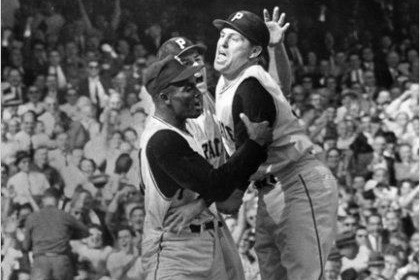
Hal Smith celebrates with teammates after giving the Pittsburgh Pirates a 9-7 lead with a three-run homer in the eighth inning of Game 7 of the 1960 World Series. An inning later, Smith was upstaged as Bill Mazeroski's homer gave Pittsburgh a 10-9 win over the New York Yankees.

  So up came his backup Smith, who'd seen about as much action during the season as Burgess in a platoon arrangement. And Smith gave the Pirates supreme production out of their catcher spot this afternoon by uncorking a three-run homer to deep left on a 1-2 count to push the Pirates in front 9-7.
  Smith had shown some pop in his bat in '61 with 11 homers in 286 at-bats. And as Rosen pointed out, he knew the Yankees pitchers from having faced them while with Kansas City from 1956 through 1959.
  "They didn't scare me," he said.
  (Smith had a doppelganger of sorts at this time. Another Hal Smith also played catcher for nine simultaneous years. Also at about the same time, the actor Hal Smith was playing the town drunk on "The Andy Griffith Show.")  
  After the Pirates regained the lead, Terry relieved Coates, Yankees manager Casey Stengel's fourth pitching change of the day, and Don Hoak flied out to left. The Pirates were three outs away from their first world title in 35 years.
   “After Smith got us ahead, I just raced onto the field," Mazeroski said in “Maz and the ’60 Pirates: When Pittsburgh and Its Pirates Went All the Way,” by Jim O'Brien. "I just couldn’t wait to get those last three outs. Of course, we didn’t get those three outs; we didn’t get them before they scored two runs.”
  Richardson and Dale Long, pinch hitting for Kubek's replacement Joe DeMaestri, had back-to-back singles off Bob Friend on four pitches to set the table for the Yankees' game-tying rally, prompting Pirates manager Danny Murtaugh to summon Haddix, his fourth pitcher of the day. That capped a forgetful Series for Friend, one of the Pirates' most reliable pitchers ever in a 16-year career. He'd been shelled in two earlier starts, taking the loss both times, and had a 13.50 ERA in his three outings covering six innings. This was just his second relief appearance of the year.
  Haddix got Roger Maris to foul out to catcher Smith. Earlier the lefty swinging Maris had fouled out twice to Hoak at third and grounded out to the pitcher as he went 0-for-5.
  (Maris batted .267 for the Series with two homers. After the season he won the first of back-to-back American League MVPs after hitting 39 homers with 112 RBIs and a .283 average. The next season he broke Babe Ruth's single-season homer record in a .269-61-141 season.)       
  After Maris went out so mildly, Mickey came along to save the day. Momentarily. But he was crying in the locker room after Mazeroski handed the Yankees a crushing defeat. Mantle has called it the biggest disappointment of his career.
  (Mantle had a stellar Series with team highs of a .400 average and three homers to go with 11 RBIs. With his three homers he moved within one of Ruth's career Series record of 15, a mark he'd surpass with four more homers in subsequent Series. However, Richardson, with a .367 average, one homer and a record 12 RBIs, captured the Series MVP, the only player off a losing team that has been so honored.)
  Haddix, who the year before had pitched 12 perfect innings against Milwaukee only to lose the perfect game, no-hitter and the game in the 13th, was this day's winning pitcher courtesy Maz's heroics, despite blowing a save opportunity. He'd logged 6 1/3 innings in getting the Game 5 win, giving him a 2-0, 2.45 ledger in his only Series appearance.
  Terry, meanwhile, went 0-2 in the Series, having also lost Game 4.


In happier times, Ralph Terry is hoisted on his teammate' shoulders after completing a 1-0 victory for the New York Yankees in Game 7 of the 1962 World Series over San Francisco. Two years earlier, Terry had been the Game 7 loser after giving up Bill Mazeroski's ninth-inning homer in a 10-9 loss to Pittsburgh.

 He was redeemed two years later when he went 2-1 with a 1.80 ERA, including a 1-0 Game 7 win, as the Yankees prevailed over San Francisco in the 1962 Fall Classic with Terry winning MVP.
  Pirates starter Vernon Law was also 2-0 in the 1960 Series and appeared headed toward becoming the second pitcher in four years (Lew Burdette in '57) to go 3-0. He retired the first eight batters he faced and 12 of the first 14 before Skowron broke up his shutout with a leadoff homer in the fifth. Still, Law held a 4-1 advantage thanks to Nelson's two-run homer in the first, deep into the right-field seats, and Virdon's two-run single in the second.
  Stengel gave notice of a quick hook on this do-or-die afternoon when he came and got starter Bob Turley after Burgess' single leading off the second. Bill Stafford relieved and walked Hoak. Mazeroski, with an early small-ball contribution way before his big blow later, loaded the bases with a bunt single down the third-base line. Law grounded into a pitcher-catcher-first double play, but Virdon's hit to right made it 4-0.
  Murtaugh likewise didn't waste much time going to the bullpen with a 4-1 lead when Law ran into a bit of trouble with a single by Richardson and a walk to Kubek leading off the sixth. Elroy Face came in and got Maris to pop out, but Mantle cut the margin to 4-2 with a single plating Richardson.
  Berra then gave the Yankees their first lead of the day at 5-4 with a three-run homer, his 11th career Series four-bagger, tying him with Duke Snider for third all time. (He passed Duke next year and finished with 12, behind Mantle's 18 and Ruth's 12). Berra deposited an 0-1 pitch into the right-field seats down the line. 
  The Yanks extended the lead to 7-4 in the top of the eighth against Face on an RBI single by John Blanchard and an RBI double down the left-field line by Clete Boyer, after a walk to Berra on a full count and an infield single by Skowron with two out. Skowron was safe on a bouncer to third after Hoak threw too late trying to force out Berra. That gave "Moose" 12 hits in the Series, at that time tying him with five others for the record. 
  Shantz lined out to right after Boyer's hit, but that was it for Face, whose final line was 3 runs, all earned, over 4 innings, giving him a 5.23 ERA over 4 games and 10 innings in the Series.
  (Face was coming off a season for the ages in 1959 in which he went 18-1, all out of the bullpen, for an all-time record .947 winning percentage to go with 10 saves and a 2.70 ERA. He wasn't so lucky in the win-loss department in 1960, going 10-8, but was otherwise plenty solid with 24 saves, second in the NL, a 2.90 ERA and a league-leading 68 appearances.)
  So it was onto the fateful times at bat for Pittsburgh and New York, and all the twists and turns and heroic homers and bad hops. And a savvy stop and slide by Mickey Mantle. All overshadowed by the Magic of Maz.
  “Maz is eighth in the batting order, a spot that doesn’t exactly rank him as the greatest hitter of all time," Hoak said, "yet he comes up after the Yanks have tied the score in the ninth, and bam! I said, ‘Get out of here, you rotten, stinking, beautiful baseball.' ”

Just win, baby

  Maz's game-winner capped a bizarre Series in which the Yankees outscored the Pirates 55-27, including a combined margin of  38-3 in their three victories.
  But it was fitting that when it got close at the end, Pittsburgh should prevail. The Pirates were a model of efficiency all season, going 26-22 in one-run games, winning 15 in their final at-bat, 12 of those with two out. So efficient were the Pirates in Game 7 that they left only one runner on base. And on a do-what-it-takes team with no true superstars -- Clemente hadn't risen to that status yet -- Mazeroski was as good a hero as any.
   "All year we’ve been a fighting, come-from-behind ballclub," he said. "We always felt we could pull it out – even after the Yankees tied it in the ninth."
   Afterward, the Yankees were as much stunned as disappointed.
  “What happened to us, for cryin’ out loud, what happened?” Maris asked.
  Answered Yogi: “We just got beat, Roger, by the damnedest baseball team that me or you or anybody else ever played against.”
                                                            
  Additional background came from various sources on the Retrosheet and Society for American Baseball Research's Biography Project websites, as well as baseballreference.com.      

Friday, February 21, 2020

'41 Midsummer Classic: Behind Teddy's ballgame


With Joe DiMaggio (left) there to greet him, Ted Williams crosses the plate after hitting a three-run homer in the bottom of the ninth inning to give the American League a 7-5 victory in the 1941 All-Star Game in Detroit on July 8.

With a pair of two-run homers that gave the National League a 5-3 lead, Arky Vaughan stood to be the hero of the 1941 All-Star Game. Then he was upstaged by Ted Williams' three-run homer that gave the Americans a 7-5 victory.

By Phil Ellenbecker
  Much has been made of what a glorious year 1941 was for baseball, with Joe Dimaggio's record hitting streak, Ted Williams being the last to hit .400, the long-daffy Dodgers finally winning a pennant -- all this coming on the cusp of the U.S. plunging into World War II with the Japanese bombing of Pearl Harbor on Dec. 7, 1941. The best of times before the worst of times, so to speak, and pardon my Dickens.
  And much has been made of what a glorious showcase and centerpiece for the Splendor of 1941 that year's All-Star Game was for Williams, age 22 and in his third year in the big leagues. A three-run homer by "The Splendid Splinter" in the bottom of the ninth inning brought a dramatic climax to a 7-5 victory for the American League at Detroit's Briggs Stadium on Tuesday, July 8.
    But what I intend to do here is take a look at events that set the stage for Teddy Ballgame's blast. First of all, before Williams came to the fore, the game already had a ready-made hero in Arky Vaughan, whose back-to-back two-run homers had given the NL a 5-3 lead coming into the ninth. He had become the first player in the All-Star Game's nine-year history to homer twice in a game, and those two homers were a third of the total he had for the Pittsburgh Pirates during the regular season.
  A somewhat overlooked Hall of Famer, Vaughan was ranked the second-best shortstop of all time behind prohibitive favorite Honus Wagner in Bill James' "Historical Baseball Abstract." He wasn't voted into the Hall until 1985, by Veterans Committee vote, yet he ranked second behind Wagner in lifetime batting average among shortstops, won one batting title and three times led the league in on-base percentage, walks and triples. He was selected to nine straight All-Star Games and hit .364 in the Midsummer Classic.
  And when you stand up side-by-side the batting lines of Vaughan and Williams on July 8, 1941, you could make as equal or better a case for MVP with Vaughan, who went 3-for-4 with two runs scored and four RBIs and his two homers, over Williams, 2-for-4 with a run and four RBIs and his game-ender.
  Beyond the stolen thunder from Vaughan, another thing that sticks out to me in the prelude to Ted's Big Bang was questionable managing by NL manager Bill McKechnie, a Hall of Famer, in that fateful last half-inning.
  First up for the Nationals was Claude Passeau, who'd come on to pitch in the seventh and threw a 1-2-3 inning, then allowed a run  in the eighth. McKechnie had given his first three pitchers two innings apiece, but decided to give Passeau a chance at three and allowed him to bat. Passeau was not a bad hitter, with a .221 average and three homers in 1941, .192 lifetime with 15 homers. And McKechnie was down to four position players on the bench, and one, Hank Leiber, was inactive from June 24 to Aug. 6 so no doubt unavailable. Besides that he hit only .216 that year and one has to question why he was on the squad.
  But also available was Dolph Camilli, who was the NL MVP that year with 34 homers and 120 RBIs. You might suggest his numbers weren't that great at the All-Star break. No, he was second in homers with 16 and in RBIs with 54.
  And what had McKechnie done previously when his pitchers came up? He pinch hit for his starter, Whit Wyatt, his first time up. (Wyatt hit. 239 with three homers that year.) Paul Derringer's turn didn't come around before he gave way to Bucky Walters, a former position player and more than capable batsman (lifetime .242 BA), who doubled and scored in his first at-bat and then was pinch hit for. Passeau was the next pitcher, and his initial plate appearance was the top of the ninth.
  Passeau flew out to right, bringing up Chicago Cubs teammate Stan Hack. So after passing up a pinch-hitting opportunity for Passeau, McKechnie sends up Cookie Lavagetto, a Brooklyn Dodgers teammate of Camilli who hit .277 that year, to hit for Hack. Lavagetto grounded out to first, and Terry Moore popped out foul to the first baseman to retire the side. Moore finished 0-for-5 and was the only player besides Pete Reiser to  play the whole game for the NL.
  McKechnie's substitution of Lavagetto makes sense because Lavagetto was a third baseman like Hack, while Camilli played first. But why not let Hack, who'd singled and walked in four previous trips to the plate and was a .371 hitter that year while leading the league in hits, bat for himself, for a fifth time as he did Moore?
  (Speaking of Lavagetto and Camilli, curiously Dodgers manager Leo Durocher had Lavagetto, who drove in 78 runs with one homer in 1941, batting ahead of Camilli throughout the year -- third through fifth for Cookie and fifth and sixth for Dolph, in random checks.)
  (And speaking of five times to the plate, would-be All-Star MVP Vaughan wouldn't have gotten that opportunity because Eddie Miller was sent in for him at short to begin the bottom of the ninth).
   Second-guessing aside, the NL still had a 5-3 lead and if Passeau could hold the Americans at bay, the senior circuit could win its second straight and close its All-Star deficit to 5-4. And it appeared headed that way when Frankie Hayes popped out to second leading off.
  But Ken Keltner, batting for pitcher Al Smith in the No. 9 spot, set the winning rally in motion by bouncing a grounder off Miller at shortstop for an infield single. Joe Gordon followed with a single to right. A walk to Cecil Travis loaded the bases.
  The AL pulled within 5-4 when Keltner scored on DiMaggio's fielder's choice that retired Travis at second. Facing an 0-2 count, DiMagio sent a grounder to Miller at short, who went to Billy Herman, whose throw pulled first baseman Frank McCormick off the bag in the attempt to complete an inning-ending double play
  Enter Williams. After fouling off the first pitch from Passeau and looking at two wide ones, he sent a chest-high fastball onto the facing of the right-field roof at Briggs. Here comes Gordon, here comes DiMaggio, here comes Ted, there's your ballgame.  Bring on the jubilation.
  "Ted Williams bounded down the first-base line at Briggs Stadium like the kid he was," wrote Marc Lancaster in his account of the game for the Society of American Baseball Research's Games Project. "He clapped his hands twice as he neared the bag, then bounded over it with a joyful skip as he made his way around the bases."
  The thrill was never gone for Ted.
  “I’ve never been so happy and I’ve never seen so many happy guys,” Williams would write decades later in his autobiography. “… I had hit what remains to this day the most thrilling hit of my life.”
  A mob of AL teammates was waiting at the plate to bring Ted home, including starting pitcher Bob Feller, who sprang from the clubhouse to join the celebration. Remember, this was when the All-Star Game really, really meant something to the players involved. Detroit Free Press columnist put it in perspective:
    “That one pitch destroyed forever the theory accepted in some quarters that there is no spirit in this All-Star game … that there is nothing at stake," he wrote. “No college football team ever showed more enthusiasm than the American Leaguers when Williams came trotting through the lengthening shadows toward home plate.”
  Meanwhile, the Nationals were "plunged into gloom," according to the Free Press, after the ninth-inning gut punch.
  "Ted, you're just not human," McKechnie said, according to the 1958 issue of Baseball  Heroes magazine.

Claude Passeau, shown with Hall of Famer Dizzy Dean in the Chicago Cubs dugout in 1939, surrendered a three-run homer in the bottom of the ninth inning by Ted Williams that gave the American League a 7-5 win over Passeau and the Nationals in the 1941 All-Star Game.

National League manager Bill McKechnie played a rather pat hand in the ninth inning as the American League rallied from a 5-3 deficit to win the 1941 All-Star Game, 7-5.

  Back to second-guessing: What if McKechnie had wanted to stop the bleeding before Williams came along, or had pinch hit for Passeau and had to go to the bullpen at the start of the inning? He had three pitchers available. One, Cy Blanton, wasn't too effective that year, going 6-13 with a 4.51 ERA. Another was Carl Hubbell, an All-Star legend with five consecutive strikeouts of Hall of Famers in the '34 game. But by this time he was in the middle of his third-to-last season, although he didn't fare badly in 1941 at 11-9 with a 3.57 ERA.
  The other choice, Lon Warneke, would have been a more-than adequate replacement for Passeau. The "Arkansas Hummingbird" went 17-9 with a 3.15 ERA that season, while Passeau was 14-14, 3.35 and was making his first All-Star appearance in his sixth full year in the big leagues. Warneke had appeared in three All-Star Games.

  More second-guessing: With runners at first and third and two out in the bottom of the ninth, McKechnie could have chosen to intentionally walk lefty-swinging Williams and force a right-on-right matchup between Passeau and Dom DiMaggio. The Cincinnati Reds skipper talked it over with catcher Harry Danning and his infielders. The decision was made to pitch to Williams.
  Ted, determined to made amends for whiffing looking the inning before against Passeau, made the NL pay.“I said: ‘Listen, you lug. He outguessed you last time and you got caught with your bat on your shoulder for a called third strike,' " Williams said. " 'You were swinging late when you fouled one off, too. Let’s swing and swing a little earlier this time and see if we can connect.’”
  That he did.

Before then, back and forth

  Prior to the ninth-inning drama, the 54,674 at Briggs had witnessed a seesaw game with increasing suspense.
  After the first 4 1/2 innings had gone the minimum 21 batters (two double plays and a pickoff moving things along), Williams gave an indication of things to come by doubling in Travis with two out in the bottom of the fourth off Derringer, after Travis had doubled with one out.
  The NL squared matters in the sixth when Moore's fly out out to left off Thornton Lee scored Walters, who'd led off the inning with his double. (Moore wasn't credited with a sacrifice fly since 1941 was one of 36 of the 65 seasons before 1954 when the sacrifice fly rule wasn't in effect. Thus Moore's 0-for-5 in the box score that day.)
  The Americans went back ahead in their half of the sixth when a single by pinch hitter Lou Boudreau plated DiMaggio, following walks to DiMaggio and Jeff Heath around a fly out by Williams.
  Vaughan put the Nationals in command with his two-run blows, both to the upper deck in right, in the seventh and eighth. Enos Slaughter was aboard in the seventh after he'd greeted new pitcher Sid Hudson with a single and moved to second when Williams in left fumbled the hit. Vaughn followed with a homer for a 3-2 AL lead. After Johnny Mize doubled off Eddie Smith (the game's winning pitcher) with one out in the eighth, Vaughan went deep again, giving the NL a 5-2 lead.
  It was the Brothers DiMaggio putting the AL within 5-3 in its half of the eighth. Dom DiMaggio singled to center off Passeau, driving in Joe, who'd doubled before Williams struck out looking for the second out of the inning.
    (Dom, who patrolled center field alongside Williams in Boston for 10 years, had yielded to Joe in center and was playing right field as an All-Star after entering the game in the top of the seventh.)
  Williams' punch-out prompted some lengthy jawing between the sharp-eyed slugger, known for getting the benefit of the doubt from the umpires, and home-plate arbiter Babe Pinelli.
  Boudreau followed Dom DiMaggio with his second single of the night and advanced to two bases away from tying the game when Reiser made his second error of the game in center.
   (Reiser, whose kamikaze, wall-crashing, outfielding style contributed to a tragically short nine-year career, was amazing in his first full season of 1941, leading the NL in WAR, hitting, slugging, on-base percentage, on-base plus slugging, total bases, runs, doubles and triples. He was second behind teammate Camilli in the MVP voting.)
  (Speaking of making a splash in 1941, Stan Musial broke in with the St. Louis Cardinals on Sept. 17 of that campaign after tearing up the Class C Western Association in Springfield with a .379 average at the beginning the season and then the Double-A International League in Rochester, hitting at a .326 clip. He found himself in St. Louis in the middle of a pennant race that came up short and hit .426 in 12 games. As we said at the start, 1941 was quite the year.)
  Getting back to June 8 of '41, Passeau got out of the eighth by fanning Jimmie Foxx, one of nine Hall of Famers on the AL squad. But the roof caved in on Claude the following frame, raining Ted Williams. Maybe Passeau shouldn't have been in there.
 But maybe it doesn't make a difference. Maybe it was destined to be for Teddy Ballgame. After all, 1941 was Willams' year (among many), and he was a star among stars in the All-Star Game -- the career leader in RBIs, second in homers and third in runs scored, hits and total bases in the Midsummer Classic.
  He was never better than in 1946 at home in Fenway Park, when he went 4-for-4 with two homers, four runs scored and five RBIs in leading the AL to a 12-0 shellacking. He rose to the occasion, as he did in '41, as did Arky Vaughan. But who remembers Arky Vaughan?  Wrote Gayle Talbot of the Associated Press, he wound up “just another unfortunate who almost hit the jackpot.”

Sources: 
For play-by-play information: https://www.retrosheet.org/boxesetc/1941/B07080ALS1941.htm, https://sabr.org/gamesproj/game/july-8-1941-ted-williams-hits-most-thrilling-home-run-win-all-star-game-detroit and Baseball Heroes, 1958 issue, Whitestone Publications
For Arky Vaughan information:  https://sabr.org/bioproj/person/4e00be9b
For history of sacrifice fly info:  http://research.sabr.org/journals/sacrifice-fly 
Additional background came from various sources on the Retrosheet and Society for American Baseball Research's Biography Project websites, as well as baseballreference.com.    


Tuesday, February 18, 2020

6-27-58: Pierce's bid for perfection spoiled

On June 27, 1958, Billy Pierce of the Chicago White Sox came within one out of becoming the first left-handed pitcher to throw a perfect game in a 3-0 defeat of the Washington Senators.
Topps got his name wrong on this 1956 baseball card, but Washington Senators reserve catcher Ed Fitz Gerald made a name for himself when he broke up Billy Pierce's bid for a perfect game June 27, 1958, with a two-out double. It was Fitz Gerald's first extra-base hit of the year.

By Phil Ellenbecker
  Billy Pierce entered the night of June 27, 1958, already having compiled an impressive dossier of pitching for the Chicago White Sox during the 1950s. He'd won 20 games the previous two years, 18 another; four times an American League All-Star, three times a starter, two times The Sporting News' American League Pitcher of the Year; led the league in wins, ERA and strikeouts one time each and three times leader in complete games.
  And he'd thrown a pair of one-hitters. On this night, before 11,300 at Comiskey Park, he nearly put a cherry on top of everything he'd done previously.
  With two out in the top of the ninth inning, Pierce was working on a perfect game, bidding to become the first left-hander in major league history in the modern era to achieve perfection, and the first to throw a perfect game in the regular season since fellow White Sock Charlie Robertson in 1922.
  But Ed Fitz Gerald, who managed a middling 12-year career as a reserve catcher with a .260 lifetime batting average, managed immortality of sorts when he stroked a first-pitch opposite-field double to right. He was batting for pitcher Russ Kemmerer, only the second substitution in the game. It was Fitz Gerald's 10th hit of the season.
  (Fitz Gerald was not unfamiliar with rising to the occasion. In fact, he had grown accustomed to heroism on a larger scale when he was responsible for single-handedly capturing two German soldiers on the Rhine during World War II.)
  “The book on Fitz Gerald was that he was a fastball hitter on the first ball and liked it inside where he could pull it," Pierce told sports writer Bill Madden in 1982. "So we threw him a curve away and he hit it into right field for a solid hit.  . . .  I didn’t feel that badly about it, really. It didn’t mean much at the moment. But now  . . .  well, now I wish I had got it. It would have been nice.”  After Pierce struck out Albie Pearson on three pitches to close the game for his third straight shutout, he had to settle for yet another one-hitter as the White Sox won 3-0. He pitched another one-hitter next year.
  The performance perhaps typifies Pierce, at 5-foot-11, 160 pounds a power pitcher who had a great career but came up a bit short of perhaps moving into Hall of Fame standards.
  But he was Hall of Fame material this night. He had the Senators continually beating the ball into the turf with 12 ground-ball outs while racking up nine strikeouts as he improved to 7-5 on the season in a contest that lasted 1 hour, 46 minutes. He went to a three-ball count on only two batters and allowed six balls to be hit out of the infield. He retired the Senators on just nine pitches in the fourth, fifth, sixth, seventh and eighth.
  There were some close calls. With one out in the fourth inning, Rocky Bridges sent a liner down the right-field line that was foul by a foot. Bridges then hit a bouncer up the middle that Gold Glove winner Luis Aparicio flagged down from his shortstop position behind second. He spun and then "wheeled like the top of a swivel chair, his feet rooted to the ground" to throw out Bridges, as writer Bob Addie described it in the next morning's Washington Post.
  At the start of the sixth, third baseman Billy Goodman had to glove on a short-hop a hard shot by Ken Aspromonte but easily retired him.  Aspromonte threatened again in the ninth when he sent a dart toward second leading off the inning, but it was Little Louie to the rescue again as he speared the ball and threw to Ray Boone at first for the first out. Ken Korcheck struck out. One out from history. Then Fitz Gerald spoiled it, as he "sliced the first pitch down the right-field foul line, fair by anywhere from a foot to five feet," wrote  Jim Bigham in the Society for American Baseball Research's Game Project account. "(The distance becomes shorter with each passing year.)" Bigham added.  Comiskey anguish followed. From a 2009 article on the game in the Chicago Reader by : "The crowd 'let out a dismal wail of the doomed,' " Addie would write in his Washington Post account. "Fitz Gerald, standing on second with his first extra-base hit of the season, was booed lustily. Though 'a kindly, family man,' Fitz Gerald' will be remembered in Chicago with such All-Star villains as Hitler, Benedict Arnold, Rasputin and the income tax collector,' Addie predicted."
 While Pierce was mowing 'em down, Kemmerer was matching him nearly goose egg for goose egg, and for most of the night it was a taut pitcher's duel. Kemmerer retired 12 of 14 batters in the fourth through seventh innings. But Chicago pushed across two runs in typical "Go-Go Sox" fashion in the eighth to give Pierce a 3-0 cushion and set the stage for ninth-inning drama.


Jim Landis, more known for flashing the leather as a five-time Gold Glove winning outfielder, was a hitting star for the Chicago White Sox on the night of June 27, 1958, in support of Billy Pierce's bid for a perfect game. He went 3-for-4, singled in the game's first run and scored the first in a two-run eighth inning in a 3-0 Chisox win.
  Leadoff hitter Jim Landis, who won five Gold Gloves as an outfielder but batted only .247 lifetime, led off the inning with a single to left field, his third single in four trips to the plate. After Nellie Fox sacrificed Landis to second, Goodman drew a  walk and Sammy Esposito ran for him.
 Boone struck out, but Landis and Esposito then pulled a double steal, and both scored when Sherman Lollar singled to left.
  (The White Sox, led by nine-time base-stealing champion Aparicio, earned their "Go-Go" nickname by leading the AL in thefts every year from 1951 through 1961, with Aparicio copping the individual crown six times in that span).
  Lollar's two-run single was more than enough with Pierce on cruise control.
  Pierce gave himself enough when he scored the game's first run in the third. A lifetime .183 hitter, he led off with a double to left-center, and Landis followed with a single to left-center that chased Pierce across home plate.
  Kemmerer finished with an eight-hitter with three strikeouts and one walk as he fell to 4-6. For the year he finished 6-15 with a 4.61 ERA. He went 43-59, 4.41 ERA in a nine-year career.
  Pierce went on to post a 17-11 record in 1958, second-most wins in the league, with a 2.68 ERA, also runner-up.
  The White Sox were in fifth place after the games of June 27 with a 31-34-1 record, 11 1/2 behind the New York Yankees. (The Kansas City Athletics were surprisingly in second, 8 1/2 back). The Senators were eighth in the eight-team AL at 28-38-2, 15 games back.
  The White Sox leapfrogged Boston, Detroit and Kansas City to land in second in the final AL standings, still 10 back of New York. (The A's plummeted to seventh at 73-81, 19 behind). The Nats (first in war, first in peace, last in the American League) stayed in the cellar with a final 61-93 ledger, trailing by 31 games.
  Chicago finished runner-up for the second straight season after five straight third-place finishes. The Chisox scaled the summit the next year, knocking the Yankees out of their pennant perch for the first time in five years and only the second time in the 1950s. Chicago lost 4-2 to the Los Angeles Dodgers in the World Series after winning its first pennant since the infamous "Black Sox" team of 1919 that included eight players accused of throwing the World Series it lost to Cincinnati.
  Pierce began somewhat of a decline in 1959 as he went 14-15 with a 3.62 ERA and didn't even get a start in the World Series. But after averaging 13 wins a year his final four seasons in Chicago, he redeemed himself after a trade to San Fransciso with a 16-6, 3.90 season in 1962. He also had an 8-0 shutout of the Los Angeles Dodgers and Sandy Koufax in the opening game of an NL tiebreaker playoff, and a 1-2-3 ninth gave him the save in a 6-4 series-clinching victory. He then went 1-1 with a 2.40 ERA in two World Series starts. His 5-2 Game 6 win gave the Giants a shot at the title, but they fell short in a 1-0 Game 7 loss.
  Pierce had a 1.44 ERA in the postseason, but he didn't need a Frisco reprieve to salvage a career. He'd done too much over 13 years in Chitown. Pierce tops the franchise’s all-time list with 1,796 strikeouts and his 186 wins are fourth behind Hall of Famers Ted Lyons (260), Red Faber (254) and Ed Walsh (195). The White Sox retired his number 19 in 1987.  He was the American League’s winningest southpaw in the 1950s.
  Pierce retired in 1964 after three seasons in San Francisco. In his 18-year big league career with the Detroit Tigers, White Sox and Giants he had a 211-169 record, 1,999 strikeouts, 193 complete games, 38 shutouts and a 3.27 ERA.  He has appeared on the Golden Era veterans committee ballot for consideration in the Baseball Hall of Fame.

  While he wasn't quite at the elite level that guarantees automatic Hall entry, on June 27, 1978, he was about as elite, or perfect, as you can be on the pitcher's mound. The little lefty was King of the Hill, Ed Fitz Gerald or not.
Other no-hit bids 
  Here's how Pierce fared in his other one-hitters:
  -- June 15, 1950, vs. the Yankees: Billy Johnson led off the fifth with a single in a 5-0 win.
  -- April 16, 1953, vs. the Browns: Two-out double by Bobby Young in a 1-0 win.
  -- March 1, 1959, vs. the Senators: Leadoff double by Ron Samford in the third inning of a 3-1 win.
More White Sox perfection
  While Pierce came up short, almost 51 years to the date later, Mark Buehrle pitched the second perfect game in White Sox history, on June 23, 2009. Philip Humber added another for the Sox on April 21, 2012. The three perfect games ties the New York Yankees for the most by a team in major league history.
  When White Sox center fielder Dewayne Wise tracked down a fly ball in left-center for the final out in Buehrle's perfecto, he was staring Pierce in the face. Along the wall at U.S. Cellular Park (Comiskey had been torn down in 1991 and turned into a parking area) were portraits of the eight White Sox players whose numbers had been retired, including, second from right, Pierce. That's where Wise caught it.
  Wrote Bogira, " 'Lookit, he caught it right on your head!' screamed Pierce's wife, Gloria, in the living room of the Pierces' home in southwest-suburban Lemont."
Skipper to some deja vu

  The guy who sent Fitz Gerald up to hit, Senators manager Cookie Lavagetto, had come through with a similarly dramatic, climactic hit 21 years earlier, in the 1947 World Series for the Brooklyn Dodgers.
  With two out in the bottom of the ninth in Game 4 and the New York Yankees' Bill Bevens one out away from the first Series no-hitter in history, Lavagetto  pinch hit for Eddie Stanky and delivered -- just like Fitzgerald -- an opposite-field double to the right-field corner. But this hit not only broke up a no-hitter, it won the game, courtesy the two walks Bevens dealt earlier in the inning (he had 10 in the game) that led to the tying and winning runs crossing the plate for the Dodgers on Lavagetto's two-bagger.
  Lavagetto went 0-for-4 in the final three games of the Series as the Yankees prevailed 4-3. And that was it for Lavagetto's  10-year big league career.
  As for Bevens, he somewhat redeemed himself with 2 2/3 innings of scoreless relief (one walk) in the Yanks' 5-2 Game 7 win. And that was it for Bevens' four-year major league career.

Sources:

Game play-by-play: https://www.retrosheet.org/boxesetc/1958/B06270CHA1958.htm, with details from https://sabr.org/gamesproj/game/june-27-1958-billy-pierces-near-perfect-game and https://www.chicagoreader.com/chicago/almost-perfect-the-difference-between-a-mark-buehrle-and-a-billy-pierce-one-out/Content?oid=1188821
Biographical information on Pierce: https://sabr.org/bioproj/person/9e29afb8  and https://baseballhall.org/hall-of-fame/golden-era/pierce-billy

Biographical information on Fitz Gerald: http://www.baseballinwartime.com/player_biographies/fitz_gerald_ed.htm 
Perfect game info: https://en.wikipedia.org/wiki/List_of_Major_League_Baseball_perfect_games#Perfect_games_by_team     
Ballpark info: https://www.ballparksofbaseball.com/ballparks/comiskey-park/

Additional background came from various sources on the Retrosheet and SABR Biography Project sites, as well as baseballreference.com.    

Monday, February 17, 2020

The equalized '80s

Dwight Gooden, with 41 points in a rating system that rewards players for top-five finishes in certain categories, was the only major league player to top 41 points in the 1980s.

Mike Schmidt had three of the top four seasons among major league hitters in the 1980s. In his best season of 1981 he led the National League in seven categories and even finished fourth in average at .316, well above his career mark of .267.

By Phil Ellenbecker
  The 1980s was the decade when the elite baseball players came somewhat back to the pack. Whereas standouts of past years such as Ted Williams and Sandy Koufax stood out supremely from their peers, there wasn't as much separation between the best and the rest in the '80s when looking at my decade-by-decade ratings of the best players of each 10 years and the best individual seasons by those players. 
  But the game had been trending toward this since the 1940s, when there were 11 seasons with 40 or more points in my ratings system, led at bat by Ted Williams' 47 1/2 in 1949 and on the mound by Bob Feller's 46 in 1940. Williams had four 40-plus seasons in the decade, Feller three.
  Forty-plus seasons at bat in the 1950s came from Mickey Mantle (44, 1956) and Willie Mays (40, 1955). In the '60s, Sandy Koufax's 44 in 1965 topped all pitchers, while Triple Crown winners Frank Robinson (45 1/2, 1966) and Carl Yastrzemski (40 1/2, 1967) cracked 40 at the plate.
  Jim Rice was the lone player to reach 40 in the 1970s, leading batters with 41 in 1978. Steve Carlton came close at 39 in 1972, the season he won 27 games for a 57-win team.
   In the 1980s, pitcher Dwight Gooden was the lone player to hit 40, scoring 41 in 19 in 1985, with Bret Saberhagen pitching (37 1/2, 1989) and Mike Schmidt hitting (37,1981) the closest to 40.
  The settling effect is further exposed by looking at what brought up the bottom in the top 10 seasons for previous decades. In the 1940s, it was, by pitching and hitting respectively, 35 1/2 each; 1950s, 27 and 32; 1960s, 28 and 29 1/2; and 1970s, 29 1/2 and 28 1/2.
  In the 1980s, 25 points tied for the bottom top 10 pitching mark while at the plate it was 26 1/2.
  Which means not so much that the greats were greater in earlier years but by the 1980s, there were probably more good players to go around and spread out the standings among the leaders.
  So here's how I came up with the rankings:
  The “study” consisted of pulling out a Macmillan Baseball Encyclopedia and looking over the listing of league leaders in several categories for each year. The top five were listed in some instances, the top four in others – don’t ask me how that line was drawn. The major categories almost all included the top five. In a couple instances just the top three were listed. Sometimes just two. I think a large number of players tied had something to do with less than four, and space limitations may have come into play. I gave five points for the top ranking, four for second and so on down. Where just four were listed, it went 5-4-3-2. If there was a tie, I divided the total number of points between the rankings by the number of players who were tied. Example: Three players tied for second – 4+3+2=9 divided by 3=3 points for each player.
Robin Yount, with 32 1/2 points in 1982, ranked second among major league hitters for best seasons in the 1980s. He was the only player to squeeze in among the top four besides Mike Schmidt.
  The categories: hitting -- batting average, total bases, hits, runs, slugging average, RBIs, walks, doubles, homers, steals, homer-percentage, triples; pitching  – winning percentage, saves, hits/nine innings, strikeouts/nine innings, ERA, strikeouts, shutouts, innings pitched, wins, complete games, walks/nine innings, games pitched.
  What I came up with I think gives a fairly representative presentation of the top players and seasons. There are enough categories included to give a balance between the counting stats that reward durability and reliability and the rate stats that address pure performance. Offense takes in power, speed, batting eye and contact; pitching -- power, control, durability and dominance (i.e., shutouts). Mind you, the numbers, other than the rankings I assigned, don’t matter here, just how the players ranked in comparison with their peers. Which I think is the best way to rate players, how they rate relative to others. The 48 homers Schmidt hit to lead the NL in 1980 don't matter any more than the 22 four players hit to tie for the AL lead in 1981 (a year where numbers were shrunk by a midseason strike). Those players were simply the best over their peers in that particular year in that particular category.
Top 10 batting seasons
1. Mike Schmidt, 1981, 37
2. Robin Yount, 1982, 32 1/2
3. Mike Schmidt, 1980, 31
4. Mike Schmidt, 1986, 30 1/2
5. Don Mattingly, 1986, 30
6. Dale Murphy 1985, 29 1/2
7 (tie). Don Mattingly, 1985, 28
           Dale Murphy, 1983, 28
9. Kevin Mitchell, 1989, 27
10. Bob Oliver, 1982, 26 1/2
  This list gives impetus to the argument that Mike Schmidt was the greatest third baseman over time, overall. The Phillies third sacker, whose 10 career Gold Gloves tops all National Leaguers at the hot corner, had three of the top four batting seasons in the 1980s, including the best mark of 37 in 1981. That year he led the NL in seven categories and even finished fourth in average at .316, well above his career mark of .267. George Brett, a contemporary of Schmidt's also ranked near the top of third basemen all time, didn't have any seasons in the top 10 and in fact ranked in the AL's top five only twice -- second in his MVP year of 1985 and fifth in the 1980 season when he flirted with batting .400, finishing at .390. Brett missed too many games with injuries and didn't have quite enough power to cover too many categories.
  Coming in behind Schmidt in top-10 seasons were Don Mattingly (1986 and '85) and Dale Murphy (1985 and '83). Robin Yount, second at 32 1/2 in 1982, was the only player to break through Schmidt's domination at the top. 
  Within the NL, Schmidt led the league three times with his top 10 seasons, while Murphy was tops in his two top 10s. Mattingly was the only multi-Al leader with his two top-10 finishes, which ranked second and third in the league for the decade behind Yount's 1982.

Bret Saberhagen had the second-best pitching season and second-best overall in the major leagues in the 1980s with 37 1/2 points in 1989.
Top 10 pitching seasons
1. Dwight Gooden, 1985, 41
2. Bret Saberhagen, 1989, 37 1/2
3. Roger Clemens, 1987, 33 1/2
4. Steve Carlton, 1980, 33
5. Mike Scott, 1986, 32
6. Roger Clemens, 1986, 27
7 (tie). Mike Norris, 1980, 25 1/2
           John Tudor, 1985, 25 1/2
9 (tie). Steve Carlton, 1982, 25
           Mario Soto, 1983, 25
           Dwight Gooden, 1984, 25
  As noted above, Gooden's top 41 topped all major league players in the 1980s. He tied for ninth in 1984, giving him two top-10 seasons to tie him with Roger Clemens (third, 1987 and sixth, 1986) and Carlton (fourth 1980 and tie for ninth, 1982). Saberhagen's 37 1/2 in 1989 took second to squeeze in among the top with Gooden, Clemens and Carlton and win him his second Cy Young Awsrd. That was also second overall in the majors and dwarfed his 1985 season of 16 when he won his first Cy and the Kansas City Royals won their first World Series title.
  Nobody besides Gooden or Carlton had more than two seasons leading the NL in the decade. Gooden's 41 in '85 was the top NL mark of the decade, followed by Carlton's 33 in 1980.
  Clemens and Dave Stieb each led AL pitchers in three straight seasons. In addition to his top 10 seasons in 1986 and '87, Clemens' 24 1/2 the following year led the loop. Stieb, although he didn't come close to cracking the top 10, topped the AL from 1982 through '84 with marks between 16 and 20 1/2. This is indicative of the lower bar for leaders in the '80s but also indicative of the respect the hard-luck Blue Jays right-hander deserved.
  Stieb, a seven-time All-Star who won the second-most games of any pitcher in the 1980s and led the AL in WAR from 1982 through 1984, never finished above fourth in Cy Young voting, that coming in 1982. Pete Vuckovich won it that year. About all Vuckovich did that year was win games -- for a pennant-winning team that led the major leagues in runs scored. He went 18-6 with a 3.34 ERA, leading the AL in winning percentage and placing second in victories. Stieb, pitching for a last-place team that was last in the AL in runs scored and fourth-lowest in the majors, went 17-14 with a 3.25 ERA. He led the league in complete games, innings pitched and shutouts, and was fifth in wins and ERA.
  Vuckovich was rated the second-worst Cy Young winner ever by The Sporting News. And TSN did name Stieb the AL Pitcher of the Year for '82.
  How star-crossed was Stieb? Four times in five years, he reached the ninth inning with no-hitters and came away empty, four times with one-hitters, once with a two-hitter. Three times in 12 months, he actually reached the last out of a no-hitter, including twice within six days in 1988. He finally finished  a no-hitter in 1990. 
  Speaking of bad Cy Young choices, TSN rated Steve Bedrosion, NL 1987, as the worst. Bedrosian won it on the strength of an NL-leading 40 saves, half of the Phillies' win total that year. But all that earned him was 16th in the MVP voting. He gave up 11 home runs in 89 innings and had a 74-28 strikeout-to-walk ratio, hardly the stuff of a dominant closer.
  So who got snubbed? Well, nobody really. Nolan Ryan topped our list that year with 20 points, followed by Mike Scott with 19 (coming off a fifth-place 32-point season).
  But that's the way the decade rolled, with more noticeable parity than in the past. 
  Sources: Listings for the top five each year came from  "The Baseball Encyclopedia: The Complete and Official Record of Major League Baseball," Macmillan. Information on the worst Cy Young Award selections came from  https://www.sportingnews.com/us/other-sports/news/the-10-worst-cy-young-winners-tablet/ccb1nqu47ahi19o6s7pjz67lg.    

Tuesday, February 11, 2020

9-30-62: Wondrous Willie keeps Giants' hopes alive

Willie Mays' eighth-inning solo homer gave San Francisco a 2-1 victory Sept. 30, 1962, over the Houston Colt. 45s, sending the Giants into a tiebreaker playoff with the Los Angeles Dodgers for the National League pennant. The homer was Mays' 47th of the year. He added two in the playoffs, and his total of 49 led the NL and was the third-highest in his career. He was also second in RBIs with a career-high 141.


Stu Miller retired six straight batters after coming on to start the eighth inning and got the victory Sept. 30, 1962, in the San Francisco Giants' 2-1 decision over the Houston Colt .45s on the final day of the regular season. The Giants and Los Angeles Dodgers then met in a tiebreaker playoff series to decide the National League World Series representative.


By Phil Ellenbecker 
  On deck for the baseball Giants was a full dose of deja vu. But to get to that date with destiny, the Left Coast edition of the Giants had to survive a regular-season closing skirmish with an addition to the National League.
  The San Francisco Giants, in their fifth year after moving from New York to San Francisco, squeaked past the Houston Colt .45s, 2-1, on Sunday, Sept. 30, 1962, before 41,327 at San Francisco's Candlestick Park. That necessitated a tiebreaker playoff for the NL pennant with the Los Angeles Dodgers, in their fifth year in LA after moving from Brooklyn, in a rematch of the classic 1951 playoff between the longtime bitter rivals. The Dodgers entered Sept. 30, 1962, leading the Giants by a game but lost 1-0 to the St. Louis Cardinals at LA as Curt Simmons outdueled Johnny Podres, leaving the Giants and Dodgers each at 101-61.
  The Giants-Astros Sept. 30 tilt also settled into a pitcher's duel, between San Fransciso's Billy O'Dell and Houston's Dick "Turk" Farrell.
  Willie Mays was the fitting hero for the Giants, giving a preview of what he'd be doing in the playoff. His solo homer leading off the eighth inning, his 47th homer of the season, snapped a 1-1 tie and made a winner of Stu Miller. Miller is probably best-known as the relief ace and changeup artist who'd been called for a balk in a 1961 All-Star Game at Candlestick when a fierce wind made him waver on the mound. (He was the winning pitcher in the game.)
  Miller made Farrell grab some wind with a strikeout to close the 1962 finale, making it six batters up, six down, in Miller's two-inning stint.
  The Giants' other run also came via the solo homer route, Ed Bailey connecting with one out in the fourth for his 17th homer of the year.
  The Colt .45s, one of two 1962 expansion teams along with the New York Mets, tied the game with one out in the sixth when Jim Pendleton singled in Roman Mejias, who'd led off the inning with a single and advanced to second on Bob Aspromonte's single. O'Dell got the next two batters, and Houston's only threat from there was a leadoff double in the seventh by Farrell. But O'Dell retired the next three batters and Miller took it from there.

  (Mejias, the .45s' sixth pick in the 1961 expansion draft and 11th overall, chosen from the Pirates after nine yeares in Pittsburgh, won the team's Triple Crown in 1962 with a .286 average, 24 homers and 76 RBIs. It was by by far the best season in his nine-year big league career.)


Billy O'Dell, one of the Giants' mainstays on San Francisco's 1962 pitching staff, held the Houston Colt .45s to one run over seven innings in a no-decision Sept. 30, as the Giants won 2-1 on the final day of the regular season to tie the Los Angeles Dodgers for first  place and set up a three-game playoff.


Dick "Turk" Farrell allowed two solo homers Sept. 30, 1962, dooming him to a 2-1 loss to the San Francisco Giants and saddling him  with a final record of 10-20. But he was the ace of the expansion .45s, tying for the team lead in wins, plus he was the team's representative on the National League All-Star squad.

  Save for the homers, Farrell allowed no runners farther than second in his eight innings. He scattered nine hits while striking out four and walking one and allowing the two earned runs. He finished at 10-20, second in the league in losses, four behind the Mets' Roger Craig. But he tied for the team lead in wins with Bob Bruce. And he finished fourth in the NL in strikeouts with 203, fourth in ERA at 3.07, and was Houston's representative on the All-Star Game roster.
  O'Dell, who allowed only three runners as far as second except for the sixth, had a final line of one earned run, seven hits, four strikeouts and two walks in his seven innings. He went 19-14 on the year with a 3.53 ERA, second on the Giants in wins behind Jack Sanford's 24-7. He was third in the NL in innings pitched with 280 2/3.
  Miller, as noted before, was spotless in his two innings with two grounders, two pops, a fly out and the game-ending strikeout as he moved to 5-8. Named The Sporting News Fireman of the Year in 1961 and in the AL in 1963 with Baltimore, he wasn't so sharp in '62 with an ERA of 4.12.
  Mejias went 2-for-4 for Houston and Chuck Hiller 2-for-3 for San Francisco for the only multi-hit games between the two teams.
  Houston, which became the Astros in 1965 when they moved into "The Eighth Wonder of the World," the Astrodome, finished 1962 at 64-96. That was good for eighth place in the 10-team NL and 36 1/2 games behind the Giants and Dodgers. (They slipped in ahead of the Chicago Cubs while the Mets brought up the abyss with a mark of 40-120, sixth worst of all time and 60 1/2 back of the leaders.)
  The Giants went on to beat the Dodgers 2-1 in the playoff, just as they did in 1951. And the Giants had to rally in the ninth inning to win the deciding game, just as they did in 1951. Only this time it was from 4-2; in '51, 4-1. And unlike in '51 when Mays was on deck as Bobby Thomson hit his game-deciding homer, Mays was in the middle of the winning rally, driving in the first run of the ninth on a bases-loaded, infield single and scoring the final one from third base on an error.
  For the series Mays was 5-for-11 with a pair of homers, four RBIs and four runs scored as the Giants moved on to the World Series for the first time since winning it in 1954.
  The New York Yankees won their second straight world title and fifth in seven years when they defeated the Giants 4-3 in a Fall Classic that ended when second baseman Bobby Richardson grabbed a screaming line drive by Willie McCovey off Ralph Terry for the final out of Game 7. Mays was at second and Matty Alou at third, with the Yankees leading 1-0, providing redemption for Terry, who'd given up the ninth-inning game-winning homer in the 1960 Series to Pittsburgh's Bill Mazeroski.
  Following the season, Maury Wills was named the National League MVP over Mays in what has been recognized as one of the biggest MVP snubs ever. Wills got 209 points and eight first-place votes from the writers. Mays got 202 and seven.
  Wills made history that year with 104 steals, breaking what had been considered the untouchable post-1900 record of Ty Cobb with 96. He also tied for second in runs scored with 130 -- tied with Willie Mays. Beyond that, the only categories he ranked in the top five were hits (third) and triples (four) while batting .299. He did win the league's Gold Glove award for shortstops, one of two he won in his career.
  Meanwhile, Mays led the league in homers with 49 (third-highest in his career, playoff homers included in his total), also led in total bases, was second in RBIs (career-high 141), runs and doubles, and third in slugging average while hitting .304. And he won a Gold Glove -- one of a record 12 he won for outfielders (tied with Roberto Clemente). And Mays played on the pennant winner, Wills on the runner-up.
  "This may be the weirdest MVP pick of all time," Jonah Keri wrote in an article for espn.com.
  Mays got a reprieve of sorts -- or perhaps a make-up -- when he outpolled the Dodgers' Sandy Koufax for NL MVP in 1965, a year in which Mays batted .317 with a career-high 52 homers and 112 RBIs. Koufax was on the pennant winner while Mays was on the runner-up team.
  MVP or not, Mays' performance in 1962 probably helped turn the tide in winning over the San Francisco fans who hadn't wholeheartedly embraced "The Say Hey Kid" at the start, favoring instead Orlando Cepeda because he was a homegrown product, not a New York transplant.
  As late as 1960, Roy Terrell wrote in Sports Illustrated, on the way Cepeda had enthralled the Frisco faithful in the Giants' first two years there: "This series of events has so endeared Orlando to San Francisco fans that Willie Mays, by contrast, is considered something of a staid has-been and Willie McCovey an upstart who has yet to prove himself. Cepeda and big league baseball arrived in town the same day—April 15, 1958, on which occasion Orlando hit a home run—and San Francisco has been in love with him ever since."
  It's not that Mays didn't produce upon arriving in San Francisco. He had between 29 and 40 homers his first four years there and hit between .308 and .347. But with seasons like he kept continually churning out in the '60s, especially '62 and '65, Giants fans had no choice to say, "Hey, gotta love that Willie."


  Sources: Play-by-play information came from the Retrosheet account at https://www.retrosheet.org/boxesetc/1962/B09300SFN1962.htm . Information on MVP snubs came from https://www.thesportster.com/baseball/top-20-mlb-players-who-least-deserved-their-awards/ and  http://www.espn.com/espn/page2/story?page=keri/080805 . Insight on fan reception for Mays came from  https://theundefeated.com/features/willie-mccovey-and-the-early-san-francisco-giants/. Additional background came from various sources on the Retrosheet and SABR Biography Project sites, as well as baseballreference.com.  


Saturday, February 1, 2020

7-25-56: Clemente stars in 'What a way to end a ballgame'

Roberto Clemente is shown in his early days with the Pittsburgh Pirates. On July 25, 1956, in his second season, Clemente gave the Bucs a 9-8 victory over the Chicago Cubs with an inside-the-park, grand slam walk-off homer -- something never done before or since.


The 1955 Bowman baseball card of Chicago Cubs pitcher Jim Brosnan, back when TV was kind of a new thing. Brosnan, who'd just come into the game, surrendered a bases-loaded, inside-the-park homer on his first pitch to Roberto Clemente, giving Pittsburgh a 9-8 victory over the Cubs on July 25, 1956.

By Phil Ellenbecker    
  In 1956, Roberto Clemente was a few years away from truly launching what was to become a legendary career. He did bat .311, a substantial improvement over .255 in his rookie year of 1955. But he slipped to .253, .289 and .296 the next three years. It wasn't until he hit .314 and finished eighth in National League MVP voting in the Pittsburgh Pirates' world championship season of 1960 that he began to establish himself as a player to watch for years to come.
  But back in 1956, on Wednesday, July 25, Clemente flashed the potential and excitement he could bring to the game with one of the most wondrous hitting, and base running, feats imaginable.
  It's exciting when someone hits walk-off homer to win a game, right?
  And it's exciting when someone hits grand-slam homer, right?
  And it's exciting when someone hits an inside-the-park homer, right?
  Well, imagine if someone combined all three with an inside-the-park, walk-off grand slam. That's what Roberto delivered to give the Pirates a 9-8 victory over the Chicago Cubs, sending 12,431 gathered at Pittsburgh's Forbes Field on the way home in what must have been a frenzy. Clemente's homer trifecta had never been done before, nor since.
  Clemente's dash, described as a "Merriwell Finish" in a Pittsburgh Post-Gazette headline, capped a 2-for-5 day with five RBIs and two runs scored in a seesaw battle that saw the Pirates go up 4-0 through six innings, and the Cubs move in front with a seven-run eighth inning.
  With the Cubs holding an 8-5 lead, Hank Foiles, batting for relief pitcher Nelson King, started the last half of the ninth by drawing a walk off Turk Lown. A single by Bill Virdon and walk to Dick Cole loaded the bases. Jim Brosnan relieved Lown.
  On Brosnan's first pitch, high and tight, Clemente launched a shot over Jim King's head in left field. "After the ball struck the fencing, it rolled along the cinder warning track toward center field," wrote  Steven C. Weiner in an article for the Society for American Baseball Research's Games Project. "The three runners easily scored, and Clemente ignored the outstretched arms and stop sign of Pirates manager and third-base coach Bobby Bragan as the relay throw came in from center fielder Solly Drake to Ernie Banks to catcher Hobie Landrith."

  As reported by the Post-Gazette: “He made it just in front of the relay from Ernie Banks. He slid, missed the plate, then reached back to rest his hand on the rubber with the ninth Pirate run in a 9-8 victory as the crowd of 12,431 went goofy with excitement.”
  It was Clemente's sixth homer in a year he had seven.
  (Clemente could do everything but wasn't a prolific home-run hitter. He didn't reach double digits until 1960, his season high was 29 in 1966 and he hit 240 in his career.)
  Bragan didn't fine Clemente for running through his stop sign, which was somewhat of an upset, since he had a penchant for fining players, including Clemente -- $25 for missing a squeeze sign earlier in  the season.
  “Clemente tied up the game, for sure and I threw up the stop sign. … After all, we had some long-ball hitters coming up, no one out and getting Bobby home with the winning run looked easy," Bragan said in The Sporting News, referring to Clemente with an Americanized first name (he was also called Bob) that Roberto didn't care for.

  Said Clemente to The Associated Press: “I say to Bobby: ‘Get out of my way, and I score,’ Just like that. I think we have nothing to lose, as we got the score tied without my run, and I score, the game—she is over and we don’t have to play no more tonight.”
  In retrospect, Clemente's transgression looks not-so-harmless yet as heroic as Enos Slaughter running through a third-base stop sign to score the winning run in the 1946 World Series. In fact both actions look brilliant.  In an article titled "The Greatest Forgotten Home Run of All Time" for The Massachusetts Review in 2015, Martin Espada wrote, "What Roberto Clemente accomplished in Pittsburgh on July 25, 1956, stupefied the tobacco-spitting baseball lifers all around him precisely because it transcended baseball, entering the realm of pure theater and then myth. Even his defiance of authority that day — running through hapless Bobby Bragan’s sign — enhances the quality of the legend.”
  Getting back to more mortal matters, the Cubs began to make things interesting that day with their big eighth. Bob Friend, who'd fairly sailed through the first seven innings, yielded four singles in five at-bats to pinch hitter Don Hoak leading off, Drake, Dee Fondy and Banks. Jerry Kindall, pinch running for Hoak, scored on Fondy's base rap.
  Elroy Face relieved Friend, and rather than put out the fire he spread it by surrendering two-run doubles to Walt Moryn, Eddie Miksis and Hobie Landrith, around a walk to Jim King, making the score 7-4 Cubs. Face got out of the inning by striking out Kindall and Drake.
  (Face hadn't quite yet become the premier reliever he would be in the late '50s, although he did lead the league in games pitched that year with 69 as he went 12-13 with four saves. Two years later he led the NL in saves with 20. In 1959 he went 18-1 out of the bullpen, fifth in the league in wins, and set a record for single-season winning percentage that stands today.)
  The Pirates bit into the margin with Jack Shepard's double and Eddie O'Brien's RBI single in their half of the eighth. The Cubs answered with a single run in the top of the ninth on back-to-back-to-back singles by Banks, Moryn and King with two out. Cubs 8, Pirates 5.  Exit Face, enter King, who struck out Miksis on three pitches.
  And enter Roberto to end it all.
  What ended as somewhat of a slugfest began as a pitcher's duel between Friend and Cubs starter Warren Hacker. Dale Long, who earlier in the year had set a major league record with homers in eight straight games, broke up Hacker's shutout with a two-run homer, Clemente aboard on a single, in the fourth. It was Long's 20th homer of the year, setting a record for Pittsburgh left-handed hitters, and he'd hit seven more for his career high.
  Clemente's sacrifice fly scored another run in the fifth after a single by Friend and double by Virdon. Consecutive doubles by Frank Thomas and Shepard in the sixth increased the Pirate lead to 4-0 and ended Hacker's day as he gave way to Vito Valentinetti, who retired six straight batters before Lown took over to start the eighth.
  Hacker finished with a line of four runs allowed, all earned, in his five innings with no strikeouts and one walk.
  Going into the eighth Friend had a four-hit shutout with eight strikeouts and no walks. The final box score showed 7 1/3 innings, four runs, all earned, nine Ks and still no walks.
  (One of the more solid NL hurlers of the 1950s and '60s, Friend in his sixth year had a then-career high in wins in 1956 at 17-17 with a 3.46 ERA, earning his first of four All-Star Game selections. He went 196-266 with a 3.57 ERA in 16 years.)
  With the strikeout he got to get the Pirates out of the ninth, Nellie King picked up the win to move to 4-1 on year. With the gopher granny he surrendered to Clemente, Brosnan fell to 3-5.
  (Brosnan, in the days before Jim Bouton's chronicle of his 1969 season, pioneered the baseball diary with "The Long Season" and Pennant Race," written about his 1959 and '61 campaigns. Referred to by teammates as "The Professor," he also authored magazine articles during his playing career and was a writer by profession after retiring from baseball. And he wasn't too shabby a relief pitcher, five times finishing in the top 10 in saves.)
  Besides Clemente, other hitting standouts for the Cubs included Virdon, 4-for-5 with a run scored, and Shepard, 3-for-4 with a run and an RBI.
  If not for Clemente, fellow legend Banks might have been the star of the game. "Mr Cub," more known as a home-run hitter, had four singles in five at-bats with two RBIs and a run scored. He also had six assists and two putouts from the shortstop position he established himself at before moving to first base in the 1960s. Moryn was 2-for-5 with two RBIs and a run scored for the Cubs.
  The day's events left the Pirates in fifth place in the NL, 13 1/2 games back of first-place Milwaukee. The Cubs were in seventh, 16 back.
  Eventually the Pirates faded to finish seventh at 66-88, 27 behind first-place Brooklyn. The Cubs brought up the eighth-place bottom at 60-94, trailing the Dodgers by 33.
  As for Clemente, "The Great One," after five years on the cusp he played in his first All-Star game in 1960, the first of eight straight years he would appear and 12 of 13. At .314 his batting average was his second .300 season, also beginning a stretch of eight straight and 12 of 13. Only in 1968, "The Year of the Hitter," did Clemente miss out on .300, at .291, and an All-Star Game appearance. He also won 12 straight Gold Gloves, tied for most among outfielders, consecutive and overall.
  In his 18-year career, Clemente batted .317 with four titles and an even 3,000 hits. His life came to a tragic end when he was killed at age 38 in a plane crash off the Puerto Rican coast while helping deliver relief to earthquake victims in Nicaragua. The Puerto Rican native was elected to the Hall of Fame in 1973 in a special election that waived the mandatory five-year waiting period.

  "He had about him the touch of royalty," baseball commissioner Bowie Kuhn said of Clemente.
  July 25, 1956, could be seen as his coronation.
  
 Sources: Basic play-by-play came from Retroshoot at www.retrosheet.org/boxesetc/1956/B07250PIT1956.htm, enhanced by the Society for American Baseball Research Games Project article at  abr.org/gamesproj/game/july-25-1956-roberto-clemente-hits-inside-park-walk-grand-slam-lift-pirates and a Massachusetts Review article at lithub.com/the-greatest-forgotten-home-run-of-all-time/ . Attribution help came from /www.chicagotribune.com/news/ct-xpm-1986-05-29-8602080608-story.html and bleacherreport.com/articles/1149087-21-facts-you-may-not-know-about-roberto-clemente-on-the-anniversary-of-his-debut. Additional background came from various sources on the Retrosheet and SABR Biography Project sites, as well as baseballreference.com.