Lifetime journalist and baseballf fan who grew up with the Royals

Tuesday, March 10, 2020

NL 1934: Dodgers show up, shut up Giants

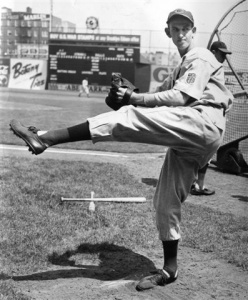
Brooklyn Dodgers pitcher Van Lingle Mungo helped spoil the New York Giants' 1934 Natonal League pennant hopes when he beat them 5-1 on the next-to-last day of the regular season. Mungo struck out the last three batters to close out the victory.
When asked in January 1934 about the Brooklyn Dodgers' chances in the upcoming National League pennant race, New York Giants player-manager Bill Terry said, "I was just wondering whether they were still in the league." Those words came back to haunt him at the end of the season as the Dodgers beat the Giants in two straight games to knock their intrarcity rivals out of pennant contention.

By Phil Ellenbecker
  Some hot air on the Hot Stove League circuit by Bill Terry provided bulletin-board material for the Brooklyn Dodgers in 1934 and might have cost Terry's New York Giants a pennant.
  Asked in late January at the annual New York Baseball Writers Dinner about the coming National League pennant race, Terry, player-manager for the defending World Series champion Giants and the last National Leaguer to hit .400 with a .401 mark in 1930, mentioned Pittsburgh, St. Louis and Chicago as the teams to beat.
  "Do you fear the Dodgers?" he was asked of the team that finished sixth in the eight-team NL the year before.
  "I was just wondering," said Terry, "whether they were still in the league."
  Well, the Dodgers were still in the league on Sept. 29 and 30, 1934, and the Giants would have to play them, and beat them, to have a chance at a pennant.
  As the moment of reckoning neared, Dodgers' President Judge McKeever said, with respect to Mr. Terry, "We'll make him eat those words."                                                              Manager Casey Stengel added, "Yes, and if it chokes him, that will be all right, too."
  And the Dodgers, pegged "The Daffiness Boys" in those days, had the last laugh, as they defeated the Giants 5-1 and 8-5 in 10 innings at the Polo Grounds on the final two days of the regular season. Those results, combined with St. Louis' 6-1 and 9-0 wins over Cincinnati, gave the Cardinals the flag by a two-game margin over the Giants. A Giants win and Cardinals loss on the final day would have forced a best-of-three tiebreaker playoff.
  St. Louis, which went on to beat Detroit in the World Series, finished 95-58 in the regular season; New York was 93-60.
  The Dodgers, in their first season under Stengel at the start of a 25-year Hall of Fame managerial career, again finished sixth with a 71-81 record, the second of six straight losing seasons.
  Dodgers ace Van Lingo Mungo set the tone for Brooklyn's rousing weekend by tossing a complete-game five-hitter Saturday. He struck out seven and walked three as he finished the season with an 18-16 record and 184 strikeouts, good for second in the NL behind St. Louis' Dizzy Dean's 195. He was seventh in the league in wins.
  Mungo finished with a flourish, striking out Travis Jackson, George Watkins and pinch hitter Lefty O'Doul, a lifetime .349 hitter, in succession in the ninth inning after Terry had singled leading off the inning and Mel Ott walked on four pitches. Watkins and O'Doul were caught looking.
  Mungo, who had a 1969 song by jazz pianist and vocalist Dave Frishberg named after him, gave himself all the help he needed at bat earlier in the game. He led off the fifth with a single and came around to score the game's first run on Lonny Frey's single. Mungo made it 2-0 the next inning with an RBI single. The Dodgers tacked on another run in the seventh when Sam Leslie singled in Frey. Brooklyn bumped the cushion to 5-1 in the ninth when Tony Cuccinello singled in Len Koenicke and Leslie scored on a bases-loaded walk to Al Lopez.
  Roy Parmalee (10-6) took the loss for the Giants, giving up 10 hits and three runs, all earned, in eight innings.
  Watkins kept Mungo from a shutout with a solo homer in the seventh.
  It looked like the Giants might be headed toward payback and a possible winner-take-all showdown with St. Louis when they took a 4-0 lead after one inning Sunday. But the Dodgers pecked away with single runs in the second, fourth and sixth innings, then tied the game with two runs in the eighth when Koenicke doubled in a run and Leslie scored on a wild pitch.
  Brooklyn scored three runs, two of them unearned, to take control in the 10th. Leslie led off the inning with a single off Hal Schumacher, who'd relieved starter Freddie Fitzsimmons in the eighth. Cuccinello's double put runners at second and third and brought on Hall of Famer "King Carl" Hubbell. The Giants' "Meal Ticket" struck out relief pitcher Johnny Babich, but the Dodgers went ahead on an error by shortstop Blondy Ryan with Lopez batting. Two more runs scored on a fly out by Glenn Chapman and single by Buzz Boyle.
  Babich, the Dodgers' fourth pitcher of the day, retired Hughie Critz, Terry and Ott on a fly out and two ground outs in the bottom of the 10th to slam the door on the Giants.

Casey Stengel, shown with baseball commissioner Kenesaw Mountain Landis, was in the first year of a 25-year managerial career when he took over the Brooklyn Dodgers in 1934. His Dodgers only came in sixth in the National League, but they had the plesaure of keeping their intracity rivals, the New York Giants, from winning a pennant by beating them in two straight games to close the season.
  Terry and Ott, two more Hall of Famers, and the Giants' No. 3 and No. 4 hitters, went 0 for 6 in their final three trips to the plate each. "Master Melvin," the National League's all-time home run king until 1965, was 0-for-5 in the game and 0-for-8 in the final two games.
  Babich got the win with two perfect innings and finished the season 7-11.
  Cuccinello shined at the plate for the Dodgers, going 3-for-4 with two runs scored.
  Schumacher was hung with the loss, giving him a final mark of 23-10. He ranked second in the NL in wins behind Dean's 30. The Giants' three pitchers on the day had a combined 62 wins on the season, with Hubbell fourth in the NL at 21 and Fitzsimmons tied with Mungo for seventh at 18.
  As it turned out, with the Cardinals breezing in St. Louis the Dodgers' win was academic. The Cardinals still would have won the league by one game with a Giants win.
  But considering Terry's words of derision in January, it had to be sweet for the Dodgers to close with not one but two straight wins over their intracity rivals on the weekend. And they made their business manager, Bob Quinn, look like a prophet. Quinn had some harsh words in the Jan. 25 New York Evening Post when appraised of Terry's remarks.
  "I doubt very much if Terry made that remark but if he did, it ill befits a manager of a championship ball club, particularly a manager who was so thin-skinned himself that he was very much perturbed about writers picking his team to finish last in 1933," Quinn was quoted as saying in a 2005 "The Big Apple" blog post by Barry Potik. "And the Brooklyn club may fool Mr. Terry by being the team to prevent him from repeating his triumph of last year. At least, we'll let him know we are still in the league."
   On Oct. 1, 1934, Brooklyn’s City Hall sported a huge sign over its entrance, and the letters spelled out, “Is Brooklyn still In The League?” An equally large postscript aimed at the towers of Manhattan read, “You bet we are!” 
  Touche.  

Sources:
Play-by-play: https://www.retrosheet.org/boxesetc/1934/B09290NY11934.htm  and https://www.retrosheet.org/boxesetc/1934/B09300NY11934.htm                                     

1951: Garver toils away for 20 with hapless Browns

Ned Garver had 20 of the St. Louis Browns' 52 victories in 1951.  He became the first hurler to reach the 20-win plateau for a last-place team since Hollis "Sloppy" Thurston for the Chicago White Sox in 1924. (New York Times Photo)


By Phil Ellenbecker 
  I can't help it, this is how my devious mind works. But when I hear the name Ned Garver, I can't help thinking of Fred Garvin, a character Dan Aykroyd played on "Saturday Night Live" in the late 1970s.
  Yes, we're talking about Fred Garvin, Male Prostitute.
  Now, I'm not accusing Ned of any nefarious activity, but in a way you could compare the work he did on the pitching mound for the St. Louis Browns in the early 1950s with that of a prostitute. A thankless job, maybe, but Garver went about his profession in an earnest way, much like a working woman. He worked hard for his money.
  And in the process he won 20 games in 1951 -- for a team that won 52 games and lost 102, 46 games behind the New York Yankees and 10 behind the next-nearest team in the American League. Steve Carlton is renowned for winning 27 games for the 1972 Philadelphia Phillies, who won 59. That's 46 percent of his team's victories. Garver can't match that, only winning 39 percent, but his is still a notable feat, perhaps the only notable feat for the 1951 Browns besides sending a midget up to bat.
  Garver's grit earned him second place in voting for the American League MVP in a close vote behind Yogi Berra. Garver also finished second in the AL and led all AL pitchers in WAR, the modern-day metric that calculates the number of wins a player provides his team compared with a replacement-level player (wins above replacement).
  Winning 20 games for the 1951 Browns, the fourth-most victories in the AL that year, was not going to be easy no matter how Garver went about it. But to say it was an uphill battle would be an understatement. 
  One day into the 1951 season, the 5-foot-10, 160-pound fourth-year right-hander had an 0-1 record and a 32.50 ERA. That dubious number is courtesy of the six runs he gave up, all earned, in 1 2/3 innings against the Chicago White Sox on April 17, before all of 5,660 fans who showed up for Opening Day at St. Louis' Sportsman's Park to see the Brownies get thumped 17-3. (Garver was the Browns' Opening Day starter for four straight years.)
 As he did all season, Garver didn't let the initial setback faze him. Four days later in Cleveland, he tossed a complete game five-hitter as St. Louis won 9-1. And Garver's ERA dropped to 5.91.
  And so he proceeded to plug away, through the sometimes bitter but ultimately a sweet ending, as he picked up his 20th win on the final day of the season.
  For the most part, it was Garver's game to win or lose all season long. Of his 30 starts, he went the distance in 24 of them, leading the American League in complete games for the second straight season.
  By May 7, Garver's ERA had dropped to 3.69, and for the rest of the season he kept it between 3.60 and 4.85, finishing at 3.73 to go with his 20-12 record in 246 innings.
  He put together winning streaks of three early, four and three in midseason in a stretch where he went 7-1, and four at the end.
  Garver's record was sitting at 12-4 on July 15, but he went 4-8 over his next eight decisions to fall to 16-12. Then came his closing push.
  Garver won a 3-2 decision in 10 innings at Washington on Sept. 18, scattering nine hits, and four days later threw a seven-hitter at the White Sox as the Browns won 5-1 in Chicago.
  Garver moved within one of the magic 20-win number Sept. 26 as he beat Detroit 7-1 at Sportman's, again on a seven-hitter.
  Garver ended the season the way he began it, pitching at home against the Chicago White Sox, only this time with far better results as the Browns won 9-5. Garver survived 11 hits and two walks as the ChiSox left nine men on base.
 A crowd of 14,771 showed up at Sportman's Park that day, the Browns' third-highest attendance of the season. So good times were had by all as Ned went out like a lion.
 But as good as he was late, Garver was downight dominant from July 1 through July 20. In four straight complete games he allowed only one earned run each time out for a 1.11 ERA. 
 He began the stretch with his low-hit game of the season, a two-hitter, as St. Louis beat Chicago 3-1 at Comiskey Park on July 1. Garver was coming back after missing two weeks with arm tenderness.
 Only a 1-0 loss to the New York Yankees on July 20 kept Garver from putting together his second four-game winning streak in nine decisions.
 The Yankees, who were in the middle of a record five-year streak of winning the World Series, won on Bobby Brown's eighth-inning single that drove in Tom Morgan, who pitched a shutout to finally stop Garver.
  The Browns drew 15,212 that day to Sportsman's, their second-highest crowd of the season. Their highest was the 18,369 on hand Aug. 18 for the Browns' celebration of the 50th anniversary of the American League. That was also the day Bill Veeck, in the most famous publicity stunt the maverick owner ever put on, trotted out midget Eddie Gaedel to lead off the second game of a doubleheader.
 Garver happened to start the first game that day, dropping a 5-2 decision to Detroit. So the Browns' three biggest crowds of the season showed up to watch their most distinguished performer.
 While Garver was mowing 'em down in July, he was rewarded by getting the start for the American League in the All-Star Game in Detroit on July 10. And he was as just as successful against the NL's best as against his regular-season AL foes in the only All-Star appearance of his career, allowing one hit and one unearned run in three innings. The NL won the game 8-3.
 Before his July 1-July 20 hot streak, Garver was almost as masterful from May 27 through June 5, allowing only four earned runs in three complete-game starts for a 1.33 ERA as he went 3-0. He threw his only shutout of the year June 1, stifling Boston 4-0 on eight hits. Six-time batting champion and lifetime .344 hitter Ted Williams was 1-for-4 against Garver. Williams hit .416 lifetime against Garver but could only muster .294 (5-for-17) in 1951.
  Garver's command of his slider no doubt helped him tame Williams.
   "Ted Williams always said that he could not pick up the spin from my slider," Garver said in an article by Gregory H. Wolf  for the Society for American Baseball Research's Biography Project. "That pitch made the difference in my major-league career.”
  Not nearly so dominant but still victorious June 10, Garver gave up a whopping 18 hits but went the distance and won his fourth straight as the Browns outlasted Washington 10-9. He was rocked again June 16 by Boston, giving up 10 runs and three homers in seven innings as the Red Sox won 10-5.
  But in his next start Garver was sharp again with his two-hitter, and off on another roll.
  As can be seen by the scores of the June 10 and season-ending games, the Browns, despite their dismal record, weren't always guilty of nonsupport behind Garver. They scored in double digits behind him in three games and averaged 4.7 runs a game, better than their overall average of 4.0 that was last in the American League. However, they averaged only 2.0 in Garver's 12 losses.
  When it came to going for 20 wins on Sept. 30, Garver showed the perseverance and resourcefulness that had carried him all season. Starting on three days rest for the third straight start, he looked shaky early, giving up two runs apiece in the third and fourth innings, but he held the White Sox to one run over the final five innings.
  He also helped himself by going 2-for-4 at bat with his first homer of the season, snapping a 4-4 tie. Garver batted a career-high .305 (29-for-95) with nine RBIs in ’51. Yes, it was a career year for him all around.
  Garver also got plenty of other help as the Browns rapped out 13 hits, led by Fred Marsh who went 3-for-4 with three RBIs and a two-run homer. St. Louis scored two runs apiece in four separate innings.
  The turnout of 14,771 that Sunday for their third-highest crowd of the season was almost four times the Browns' average attendance, and they saw an eyeful. Besides Garver getting his 20th and the Browns getting some runs, Veeck treated the crowd to a pregame basketball contest between the Harlem Globetrotters and a team made up of former college stars and Browns players, on a court set up in the infield between second and third base. After that, one of the basketball players, accomplished accordionist Tony Lavelli, gave a pregame concert.
  And showing his ever-present sense of humor, Veeck, who'd bought the Browns in July 1951, rearranged the outfield flags depicting the position of all eight AL teams, so that the Browns sat on top, in first place.
  Garver, who won two games in relief in 1951, became the first hurler to reach the 20-win plateau for a last-place team since Hollis “Sloppy” Thurston of the Chicago White Sox in 1924. Others who've done it are Howard Ehmke (Boston Red Sox, 1923), Carlton and Nolan Ryan (California, 1974). Garver remains the only live-ball era pitcher to win 20 games on a club that lost 100 or more.
  He was also the first Browns pitcher to win 20 games since Bobo Newsom in 1938.
  Garver was considered one of the game's great sportsmen, always likable, approachable and good-natured, but the 1951 MVP vote stuck in his craw. Berra the Yankee had 184 balloting points to 157 for Garver. Those two along with Allie Reynolds, another Yankee, tied for most first-place votes with six, but Garver got only two second-place votes.
  "I was called by The Associated Press in Cleveland," Garver said. "I was told that I won the night before the award was announced. The Associated Press congratulated me for being the MVP. The next morning they called me again and told me they were sorry, but I didn't win the award after all. Apparently, New York writers left me off the ballot entirely. I don't have any bitterness toward baseball except for this."
 
St. Louis Browns pitcher Ned Garver presents a trophy on behalf of his teammates to team president Bill Veeck, center, a few hours after Veeck fired unpopular Rogers Hornsby as manager. The trophy bears the inscription, "To Bill Veeck: For the greatest play since the Emancipation Proclamation. June 10, 1952. From the Players of the St. Louis Browns." (AP photo)
  With his small stature, Garver wasn't a hard thrower, so he got by on smarts and finesse. "Blessed with superior command of his breaking balls, Garver threw few pitches in the strike zone and rarely gave batters a 'good' pitch to hit," Wolf wrote.
  “I was a sinker-slider ball pitcher,” he told Wolf. “I accidentally developed the slider playing catch in St. Louis. I had good control and could throw from different spots — sidearm or overhand. I already had a curveball and a sinker. All of a sudden I threw a slider. I could feel it when it left my hand. I threw the ball again with the same pressure from my finger, and that son-of-a-biscuit moved."
  Garver, whose previous high in wins had been 13 in 1950, never had it quite so good after 1951, although he had his moments and reached double figures in wins eight of his 14 years. Bothered by arm and neck woes, he slipped to 8-10 in 1952, although he had a lower ERA, 3.60, than in '51.
  Besides the injuries, Garver also had to adjust to a new manager. Zachary Taylor, who Garver credited with being a big influence on his development -- "like a father to me" -- had been replaced by Rogers Hornsby. Hornsby may be the greatest right-handed hitter in the game's history. But he was never known as Mr. Personality.
  "(Hornsby didn't help) your attitude, confidence (or) your approach to hitters," Garver said. "Good God, I played for (him) in 1952, and he didn't even know your name."
 Once in a hotel elevator, Hornsby derided Garver for walking the opposing pitcher in the game that day. The problem was Clint Fannin, not Garver, was the guilty party.   
  Hornsby lasted only 51 games before Veeck gave him the boot. When Veeck got rid of the Rajah on June 8, the relieved and excited players presented their owner with a 3-foot trophy they had inscribed, “To Bill Veeck: For the greatest play since the Emancipation Proclamation.” Pitcher Gene Bearden said, “They ought to declare a national holiday in St. Louis.”
  Garver never won more than 14 games in a season after '51 as arm and leg problems continued to plague him. It also didn't help that of the four teams he played for, only the Tigers in 1955 had a winning season.
  Garver finished his career with a 129-157 record and a 3.73 ERA.
  A farm boy from Ney, Ohio (population 300) born on Christmas Day in 1925, he retired to the Ney area and continued to build on farming investments he'd made through the years while also working for a local meat packing company.
  Garver died Feb. 26, 2017, at age 91. An entirely honorable life. An entirely honorable baseball career. But boy, did he do some dirty work, in an entirely honorable way, for the St. Louis Browns in 1951.

Sources:
Ned Garver's 1951 pitching log: https://www.retrosheet.org/boxesetc/1951/Kgarvn1020041951.htm  
Additional background came from various sources on the Retrosheet and Society for American Baseball Research's Biography Project websites, as well as baseballreference.com.  


Friday, March 6, 2020

8-1-72: Padres' Colbert 'Mans' up

Nate Colbert set a major league record with 13 RBIs in a doubleheader and tied the record for homers in a twin bill with five as the San Diego Padres swept the Atlanta Braves on Aug. 1, 1972.
Stan Musial set a record for homers in a doubleheader with five for the St. Louis Cardinals on May 2, 1954. In the stands that day in St. Louis was Nate Colbert, who 18 years later would tie Musial's record.
By Phil Ellenbecker
  As a lad growing up in St. Louis, Nathan Colbert lived about 10 minutes away from Sportsman's Park, home of the St. Louis Cardinals, and enjoyed going to games there and taking in the exploits of players such as hometown hero Stan "The Man" Musial and Jackie Robinson, the pioneer who broke the major league color line in 1947 and once signed Colbert's glove. 
 Young Nate had justed turned 8 when he attended a doubleheader May 2, 1954, at Sportsman's. What he witnessed that day was history, as Musial set a record for homers in a doubleheader with five as the Cardinals split the Sunday twin bill with the eventual '54 world champion New York Giants.
  What the grown-up Colbert did 18 years later was make some history of his own by matching Musial's record for homers in a doubleheader as the San Diego Padres swept the Atlanta Braves on Tuesday, Aug. 1, 1972, in a twinight twin bill at Atlanta's Fulton County Stadium.
 The 6-foot-2, 205-pound first baseman not only tied Musial's mark, he did him a little better by going 7-for-9 in the two games with seven runs scored and 13 RBIs. Musial had went 6-for-8 with six runs and nine RBIs on his record-setting day.
  With those 13 RBIs Colbert set a record for runs driven in for a doubleheader, a feat matched in 1993 by the Cardinals' Mark Whiten, in Cincinnati. The previous record was 11, held jointly by Earl Averill (1930), Jim Tabor (1939) and Boog Powell (1966). Colbert’s 22 total bases broke Musial’s record of 21. 
   "The best single day ever enjoyed by a major-league hitter," Bob Carroll termed it in a 1982 article for The National Pasttime, a publication of the Society for American Baseball Research. 
   Those 13 runs Colbert brought in Aug. 1 amounted to 11.7 percent of his 111 RBIs in 1972, which Carroll noted set an all-time record for portion of a team's runs driven in -- 22.75 percent of the Padres' 488. San Diego had the worst run total in the National League and third-worst in the major leagues.
  The next-closest to Colbert in percentage of his team's RBIs was Wally Berger with 22.61 percent in 1935, when he drove in 130.
  Colbert's date with destiny was no sure thing. The night before Aug. 1, 1972, he'd injured a knee in a collision at home plate and was listed as doubtful for the games against the Braves. 
  “I didn’t sleep well,” he said. “I knew there was no way I could play both games. My back hurt, I felt down.” But with the chance to crank uphis right-handed bat in the homer-happy haven of Fulton, known as "The Launching Pad," Colbert asked manager Preston Gomez to be penciled into the lineup. And then went to work. 
  Colbert was 4-for-5 with five RBIs, three runs scored and two homers as the Padres romped to a 9-0 victory in the opener. And then there was no way he was sitting out the nightcap. He just kept on mashing with three homers, eight RBIs and three runs scored in a 3-for-4 performance as the Padres made it a sweep with an 11-7 victory.
  Colbert was geared up from the start as he unloaded a three-run homer off Ron Schueler in the top of the first inning of the opener. Two innings later he singled in another run to end Schueler's day, and Clarence "Cito" Gaston followed with a two-run homer off new pitcher Mike McQueen as the Padres' lead grew to 7-0.
  Colbert singled again the next inning and went deep again leading off the seventh with McQueen still in, giving San Diego an 8-0 lead, and a double by Gaston and triple by Gary Jestadt made it 9-0.
  George Stone was finally able to cool off Colbert when he struck him out looking leading off the ninth.
  The beneficiary of all of the thunder from Colbert and Gaston, although he didn't need that much, was Clay Kirby, who pitched a complete-game seven-hitter with seven strikeouts and two walks as he improved to 8-11.
  Schueler fell to 4-5 as he gave up six runs, all earned, three hits and four walks in his two-inning stint.
  The Padres piled it on in the nightcap, building a 7-0 lead through two innings and 9-1 after 7 1/2 before the Braves' bats woke up.

San Diego Padres coach Bob Skinner holds up five baseballs, signifying the five balls Nate Colbert, right, hit out of the park Aug. 1, 1972, which tied a major league record for homers hit in a doubleheader.
  Colbert had the big blow early with a grand-slam homer off Pat Jarvis to cap a five-run second. He'd walked and came around to score on Gaston's single the inning before against starter Tom Kelley.
  Jarvis got Colbert to ground out to third in the fourth, but Colbert found the seats again in the seventh against Jim Hardin with Larry Stahl aboard. And then for good, history-making measure, again with Stahl on base, Colbert uncorked a first pitch from Cecil Upshaw and hit this third homer of the game in the ninth, rounding out the Padres' scoring to make it 11-7. Stahl went 2-for-3 in the game with four runs scored.
  Colbert said he was just trying to meet the ball against Upshaw, a pitcher who'd always given him trouble.
  “I was shocked when I hit it,” Colbert said. “I couldn’t believe it when I saw it go over the fence. It was unreal. When I rounded second base, umpire Bruce Froemming said to me: ‘I don’t believe this.’ I told him: ‘I don’t either.’ "  
  Ed Acosta got the win for San Diego, giving up five runs, all earned, and nine hits over six innings as he improved to 3-5. He struck out three and walked two. Al Severinsen got his first save of the season with mop-up shutout relief in the ninth. It was also the last save of his three-year career that ended in 1972. (He had eight saves the season before.) The Braves had threatened mildly with two runs in the eighth before Mark Schaeffer came on to get the final out.
  Kelley fell to 5-7 after giving up four runs, three earned in his 1 1/3 innings. He gave up only one hit but walked five.
  Mike Lum went 3-for-4 for the Braves with two runs scored. Two of the Braves' bigger bats who'd each gone 0-for-4 in the first game shrugged off the collar in the nightcap. Darrell Evans went 2-for-4 with two runs and two RBIs, while Dusty Baker was 2-for-4 with two RBIs.
  However, Hank Aaron -- the biggest bopper in franchise history, two years from knocking off Babe Ruth as the all-time home run champion -- was going for an oh-for for the day before he singled in the eighth inning of the second game. That made The Hammer 1-for-5 and 1-for-7 on the day after going 0-for-2 and then taking a seat in the opener. And another big stick for the Braves, 1974 National League batting champ and .306 lifetime hitter Ralph Garr, was 2-for-7 in the two games.
 Colbert, a shining light for the Padres in their first few years of existence after joining the NL as an expansion team in 1969, was working on a career year in 1972 that included those 111 RBIs that set a career high, fourth in the NL, and 38 homers, second in the NL and tied for his best. He batted .250 and finished eighth in MVP voting.
  “How Nate ever knocked in 111 runs that otherwise dismal season has puzzled the experts ever since,” Padre statistician Mil Chipp said. 
  The 1972 Padres finished 58-95 -- 4-7 under Gomez and 54-88 under Don Zimmer, in the first of four managerial jobs for the baseball lifer who was involved in the game until his death in 2014. Gomez had been the Padres' manager since their inception before being fired. San Diego finished sixth and last in the NL West -- their fourth of six straight cellar seasons to begin their tenure in the National League. Only the 59-97 Philadelphia Phillies and 54-100 Texas Rangers in the American League had worse winning percentages in 1972.  
  The 1972 Braves finished fourth in the NL West at 70-84, one of several subpar seasons they endured in the 1970s after winning the West in 1969, the first year of divisional play after four teams were brought into the league.
  As for Colbert, he never rose to such heights again. He dropped to 22 homers and 80 RBI with a .270 average in 1973, and he was out of baseball by 1977 after 10 years, his career prematurely ended by chronic back problems. He finished with 173 home runs, 520 RBIs and a .243 batting average. He still holds the Padres’ career record for home runs (163).
 Colbert was signed by his hometown Cardinals out of high school in 1964 and then moved on to the Houston Astros organization before blossoming with the Padres, who made him their ninth pick and 18th overall in the 1968 NL expansion draft.
  A three-time All-Star, he averaged 30 home runs and 85 RBIs from 1969 to 1973, prompting Gomez to compare him to such contemporary sluggers as Willie McCovey and Willie Stargell.
  And on an August day in 1972, Colbert was the mightiest thumper of them all.

Sources:
 Additional background came from various sources on the Retrosheet and Society for American Baseball Research's Biography Project websites, as well as baseballreference.com.         

Wednesday, March 4, 2020

5-16-53: The Yankees get Byrned

Pitcher Tommy Byrne is shown on his 1956 Topps baseball card after he'd returned to the New York Yankees, where he began his career. While with the Chicago White Sox on May 16, 1953, Byrne unloaded a pinch hit grand-slam homer to hand his former team a 5-3 loss.
By Phil Ellenbecker
  The Chicago White Sox came in with a whimper and went out with a bang May 16, 1953, at Yankee Stadium.
  The White Sox and New York Yankees played many memorable games during the 1950s, but perhaps none more memorable, at least on the improbability scale, than what transpired on that Saturday afternoon before 22,966 at The House That Ruth Built. Thanks to Tommy Byrne.
  Byrne, a pitcher who grew up idolizing Babe Ruth in The Bambino's hometown of Baltimore and who pitched 11 seasons with the Yankees, struck a blow for the invaders by belting a pinch-hit grand slam homer in the top of the ninth inning that gave the Chicagos, as Yankees manager Casey Stengel used to called them, a 5-3 victory.
  Byrne's slam, one of 14 homers he hit in his 13-year career, capped a comeback from a 3-0 deficit entering the ninth.
  It certainly didn't start that way for the Pale Hose. Yankees right-hander Vic Raschi retired the first 12 White Sox he faced, 17 of the first 18, and Chicago went 18 up and 18 down in the first six innings, as Raschi coaxed a double play after giving up his first hit in the sixth, an infield single by Jim Rivera.
  But the Yankees weren't faring much better against Billy Pierce. The Chisox southpaw held the Yankees to four hits and no runs, striking out seven with one walk, through six innings.
  New York finally broke the 0-0 deadlock with two runs in the seventh on RBI singles by pinch hitter Johnny Mize and Raschi. The Yankees made it 3-0 in the eighth on a sacrifice fly by Gil McDougald off Luis Aloma, who'd just come on after Pierce walked Hank Bauer and yielded a single to Mickey Mantle, Bauer moving to third, leading off the inning.
  Bud Sheely, batting for Aloma, started the White Sox on the comeback trail with a single to right field leading off the ninth. After a ground out by Nellie Fox advanced pinch runner Fred Marsh to second, Ferris Fain walked and Minnie Minoso's grounder forced out Fain, Marsh going to third.
Ewell Blackwell, toward the end of a 10-year career in 1953, gave up a pinch hit grand slam homer May 16 to fellow pitcher Tommy Byrne that gave the Chicago White Sox a 5-3 win over the New York Yankees.
  Tom Wright singled in Marsh and broke up Raschi's shutout. The bases were loaded after a walk to Rivera, bringing in Ewell "The Whip" Blackwell, a six-time All-Star with the Cincinnati Reds winding up his 10-year
career with the Yankees. He was so nicknamed because of his side-arm delivery emerging from a 6-foot-6, 195-pound frame.
  And out of the White Sox dugout swinging a bat came Byrne, a capable enough hitter (.238 lifetime average) that early in his career the hard-throwing but wild lefty, still trying to establish himself, was asked by Yankees manager Joe McCarthy to consider moving to first base.
  Chicago manager Paul Richards, known for his shrewdness, was playing a hunch.
  “Richards asked me, ‘You ever hit this guy?’" Byrne recalled in his Society for American Baseball Research biography. ‘Yeah,’ I said, ‘about 11 years ago.’ ‘Well,’ said Richards, ‘How about going up and hitting one out of here?’ So I go up there and, after getting the count to 2-2, I don’t even remember swinging the bat, but I hit a line drive, 20 rows back in right field.”
  So Minoso, Wright and Rivera crossed the plate in front of Byrne, after Tommy's first and last homer of 1953, and all of a sudden Chicago led 5-3.
  Fritz Dorish came on for the White Sox in the bottom of the ninth and gave up a leadoff single to pinch hitter Gene Woodling. But pinch hitter Joe Collins looked at a third strike, Don Bollweg flied out to center and Bauer lined out to center.
  And the Yankees, on their way to a record fifth straight World Series title in 1953, were vanquished.
  The win left the White Sox a half-game behind the Yankees in second place in the American League. 
  But the Pale Hose, as in so many seasons during the decade, couldn't keep up with the Yanks and eventually finished third behind New York and Cleveland, 11 1/2 games back. The White Sox went 9-13 that season against the Yankees.
  Aloma picked up the win on that May 16 in his first decision in a year in which he went 2-0 with a 4.70 ERA. Raschi dropped to 2-3 and would finish 13-3 with a 3.33 ERA.
  Pierce went 18-12 with a 2.72 ERA that year and led the AL in strikeouts with 186. He holds the White Sox franchise record for career strikeouts (1,796), and his club marks of 186 wins, 2,931 innings and 390 starts are team records for a left-hander.  
  Byrne's game-winning pinch-hit grand slam definitely qualifies as the highlight of his one-year tenure with the White Sox, which lasted all of six games and 16 innings in which he somehow managed a 2-0 record with a 10.12 ERA. Likewise his short stints with the St. Louis Browns and Washington Senators were rather pedestrian. It was with the Yankees in New York, where he bookended his career, that he managed his most success, with a record of 72-40 and a 3.93 ERA, including a 1-1 mark with a 2.53 ERA in 21 innings of World Series action, one All-Star Game selection (but no appearance) and a 14th place in AL MVP voting in 1955.
  After his career, in which he finished 85-69 with a 4.11 ERA, Byrne had notable success as a businessman and politician, including two terms as mayor in his adopted hometown of Wake Forest, North Carolina.
  But when it comes to tell-your-grandkids moments, I'd have to think the time when Paul Richards summoned Tommy to swing that lumber back on May 13, 1953, is the one that would roll off the tongue most readily.

Sources:

Tuesday, March 3, 2020

8-9-74: Dick Allen, Mr. Hustle


Dick Allen settles into the batter's box against Nolan Ryan with one out in the bottom of the ninth inning, Aug. 9, 1974, at Chicago's Comiskey Park. Ryan had a no-hitter going, and his California Angels led the Chicago White Sox 1-0.
Ryan peers in for the signal from catcher Ellie Rodriguez.
Ryan wheels and delivers a 2-1 pitch to Allen.

On a check- wing, Allen grazes a curveball from Ryan and sends a bouncer into the third base-shortstop hole.

Angels third baseman Rudy Meoli, having fielded the ball on the run, has trouble getting the ball out of his glove trying to throw Allen out at first.

Allen beats out an infield single to break up the no-hitter as first baseman Bruce Bochte stretches to catch the too-late throw from Meoli.

  (Editor's warning: This game account is accompanied by frequent interjections from Harry Caray at the mike.)
By Phil Ellenbecker 
 No one has ever questioned the talent Dick Allen brought to the baseball diamond. From the time he entered the major leagues in 1964, Allen displayed the abilities of a top-caliber player along the lines of contemporaries such as Wilie Mays and Hank Aaron.
  What was so questioned about Allen, and what has probably contributed to keeping him out of the Hall of Fame, was his commitment to the game, how much effort he put into it and how much he was willing to sacrifice for his team.
  But in the book "Cult Baseball Players," in the chapter on Allen contributed by pitcher Jim Kaat, who played with Allen for the Chicago White Sox in 1973 and '74, he raves about what a good teammate and leader Allen was. Kaat probably had to be thinking of the night of Aug. 9, 1974, in making his statements.
  On that night Allen, two years removed from an American League MVP season, demonstrated the effort he was capable of putting forth. With White Sox announcer Harry Caray cheering him every step of the way, Allen showed that he could be Mr. Hustle, the type of player teammates could not only count on but who could put them on his back and carry them if need be.
  On that Wednesday night at Comiskey Park, Allen beat out a check-swing nubber down the third-base line to break up a no-hit bid by Nolan Ryan in the ninth inning, sparking an uprising that gave the White Sox a 2-1 victory.


Dick Allen at the plate was one of the most fearsome sights for American League pitchers from 1972 to 1974. He was the AL MVP in 1972 and led the league in homers in '72 and '74.

  Allen came up after Ryan had made Jorge Orta, who had been third in the league in batting average entering the game, a strikeout victim for the fourth time of the night (giving him the "Golden Sombrero"). The Angels led 1-0 on Frank Robinson's second-inning homer, and the way Ryan was humming it looked like a superb pitching effort by Kaat was going to go for naught.
  But Allen thought differently. “Old timer, we’re going to win this game,” he said to Kaat as the two headed to the dugout after the Angels were retired in the ninth, according to an article by Ken Carrano for the Society for American Baseball Research's Games Project.
  Caray wasn't discounting the Sox getting to Ryan.
  "I've seen it happen before, where a guy loses not only a no-hitter but the game," Caray said on the telecast at the beginning of the White Sox's turn in the ninth. Carey was in the fourth year of an 11-year tenure with the White Sox in his 53-year career.
  The strikeout of Orge was Ryan's 13th overall and turned out to be his last, although he continued to try to bring it."It's all powder river now," Caray said.
  So it was powder on power as Allen stepped up to the plate, and Allen was ready to deliver. Although not exactly with the power.
  On a 2-1 curveball, low and outside of the strike zone, Allen barely made contact and sent a high bouncer toward the third base-shortstop hole. A charging third baseman Rudy Meoli made a fine scoop to cut it off. But he had trouble getting the ball out of his glove, taking three extra steps while the ball stuck in the webbing. That allowed Allen to barely beat the throw to Bruce Bochte at first as umpire Jim McKean, arms flailing, declared Allen safe. (Bochte is not to be confused with the Bruce Bochy who played later in the1970s and managed four pennant winners and three World Series winners before retiring last year with San Francisco.)


Nolan Ryan was on pace to throw his third no-hitter in two years for the California Angels on Aug. 9, 1974, but had the bid broken up in the ninth inning and lost the game 2-1.

  Ryan had been denied his third career no-hitter, which would have tied Bob Feller's American League record, after tossing two the year before.
   "Oh, what a heartbreaking way to lose a no-hitter," Caray bellowed into the microphone. "Allen tried to stop his swing, but you've got to give Allen credit for hustling down the line. I've seen guys not too far away who've hit ground balls like that and they haven't run, but Allen gave it everything he had and beat it out."
  The White Sox put runners at first and second when Bochte let a hard-hit grounder right at him by Carlos May skip off his glove into right for an error. Lee "Bee Bee" Richard ran for May.                     
  Ryan's shutout was spoiled when Ken Henderson, deemed "Colonol Clutch" by Caray, singled to center to score Allen. Henderson, on the seventh pitch of the at-bat, reached out for a high, outside 2-2 fastball and dribbled a ground ball up the middle. He took second on a throw from Mickey Rivers trying to nab Richard at third.
 Bill Melton then popped a first pitch foul toward the first-base dugout that catcher Ellie Rodriguez gathered in with a one-handed stab near the stands. Two outs, 1-1 tie.


Bill Sharp, in the second year of a four-year major league career, singled in the game-winning run off Nolan Ryan in the ninth inning Aug. 9, 1974, giving the Chicago White Sox a 2-1 victory over the California Angels.

  That brought up Bill Sharp, then in the second year of a four-year career, cut short by knee injuries, during which he batted .255, including .253 in 320 at-bats in '74. He nearly won the game when, on an 0-1 pitch, he drag-bunted a low pop toward third. Meoli alertly let the ball go as it fell fair by about five feet, 15 feet away from the bag. It then took a spin upon hitting the turf and rolled foul by about a foot, just shy of the base.
  And it was closer than that to being fair, according to Harry. "Less than the thickness of a Falstaff beer bottle cap," Caray said afterward, giving a nod to the White Sox's broadcasting sponsor.
  Then, with Caray rooting for a wild pitch, passed ball, error, balk -- anything that would get Richard home -- Sharp won the game when he singled sharply to right to score Richard easily. Sharp had run the count to 2-1 when he lined a high, inside fastball past a diving Bochte. "Sox win, Sox win," roared Caray, the guy who'd make "Cubs win, Cubs win" such a trademark phrase while winding up his career with 16 years as the Bruins' announcer at WGN in Chicago.


Jim Kaat, shown in his pitching days with the Minnesota Twins, emerged the winner over Nolan Ryan as the Chicago White Sox beat the California Angeles, 2-1, on Aug. 9, 1974. Frank Robinson's second-inning homer was the only run given up by Kaat.

  Sharp made a winner of Kaat, who finished with a six-hitter with no walks and six strikeouts as he improved to 13-8 on the year.  Ryan, in falling to 14-12, had a final line of three hits allowed and five walks to go with the 13 Ks.
  "Nolan Ryan will never lose a tougher game, and Jim Kaat will never win a sweeter one," Caray said. "Ho-o-o-ly cow, what a ballgame."
  It was the second time in 10 days Kaat and Ryan had engaged in an unyielding pitcher's duel, with Kaat coming out on top both times. On July 30, the White Sox won 3-2 in 10 innings, with Ryan going the full 10 and Kaat nine.
  Afterward on Aug. 9, the camera flashed to Caray giving his wrap-up in the booth as he described Allen's pivotal infield hit with hand gestures.
  "If he'd have dogged it for a half-step, Ryan would have had his no-hitter," Caray said. "But he was hustling from the time he touched the ball up. And that ought to be a lesson to a lot of ballplayers on a lot of clubs including the Sox. It's not asking too much to run 90 feet, and here you've got a guy who's the highest-paid ballplayer in the world and he didn't give up on it, even though it looked like a routine out."

Chicago White Sox announcer Harry Caray gives his postgame wrap-up in the booth at Comiskey Park on Aug. 9, 1974. Caray is demonstrating how the ball stuck in the glove of California third baseman Rudy Meoli on Dick Allen's check-swing single that broke up Nolan Ryan's no-hitter in the ninth inning. The White Sox defeated California 2-1.

  The only thing missing, as far as Caray was concerned, was a few more thousand fans than the 11,636 who showed up at Comiskey.
  "It's a shame we didn't have 70,000 people here tonight," he said. "Well, we can't hold 70,000, but it's too bad we didn' t have 50,000. That's one of the most dramatic games I've seen here."
  All in all, this one deserved a hearty toast.
  "To Dick Allen and the White Sox and Bill Sharp and Jim Kaat and Henderson and everybody, I salute," Caray said with outstretched beer bottle.
Moving on

  Ryan, who after the game said he might have lost something off his fastball in the ninth, would get his third no-hitter later that year, with a 4-0 win over the Twins in his last start of the season. He finished with a record of 22-16 (a career high for wins) to go with a 3.29 ERA and 367 strikeouts, after a record 383 the year before, to give him three straight strikeout titles. It was his second straight 20-win season, but also his last.
  Kaat finished the season 21-13 with a 2.92 ERA, the second of his three 20-win seasons. 
  Allen, in the last of his three seasons with the White Sox before being traded, led the AL in homers (32) and slugging (.563) for the second time in three years, and maybe the only reason it wasn't three straight is because he suffered a hairline fracture of a bone in his right leg in 1973 and played only 72 games. He also hit .301 with 88 RBIs in '74.
Cases for the Hall      
  Ryan went on to throw a record seven no-hitters with a record 5,714 strikeouts and 12 K titles in a 27-year career that set a record for longevity. Needless to say, a Hall of Fame career.  
  While there's little to dispute Ryan's Cooperstown credentials, Allen and Kaat have been left outside the shrine with many claiming they should be in. Both have been finalists on the Golden Era ballot for Veterans Committee inclusion in the Hall.  
  First, the case for Kaat. "Kitty" went 283-237 in his career with a 3.45 ERA and 16 straight Gold Gloves, a record number for a pitcher. He almost pitched as long as Ryan, 25 years, and ranks 17th all time in number of games started and 31st in wins. Veteran baseball writer Tracy Ringolsby says seven of Kaat’s top 10 most comparable statistical matches are Hall of Famers, including Robin Roberts and Fergie Jenkins.
  As for Allen, he fell one vote shy of enshrinement in 2014 in Golden Era ballot voting, and George Stockburger, in a 2019 online article, said he'd be likely to make it in the next time the Golden Era committee meets in 2021.
 "According to Hall of Fame analytics such as Black Ink, Gray Ink and the Hall of Fame monitor, Allen is well beyond the standards for a Hall of Famer," Stockberger wrote. He noted Allen's WAR (the modern metric that attempts to summarize a player's total contributions to their team in one statistic) is superior to Hall of Famers from his era such as Willie Stargell and Tony Perez.
  Allen finished his 15-year career with a .292 average, 351 homers and 1,119 RBIs.
More Allen tribute

  Sharp, who played with four Hall of Famers in his short career including Goose Gossage, Ron Santo, Hank Aaron and Robin Yount, treasured being a teammate of Allen and appreciated his knowledge of the game as well as his talent. 
  “I hit right in front of Allen a lot of times, and I’ll tell you he had the greatest ability to play situational baseball I’ve ever seen, absolutely fundamentally sound," he said in an interview with his hometown Lima (Ohio) News. "He really was a five-tool player, and when he hit a ball, there was just a different sound when it came off the bat.            
  “He had a mental book on every pitcher he would face, and unlike some veterans who were reluctant to have much to do with rookies and young guys that may one day take their jobs, Dick helped me a lot.”                                           
  No doubt about it, Dick Allen was The Man for the Chicago White Sox from 1972 to 1974, and the night of Aug. 9, 1974, was a vivid demonstration of that.                 
Sources:                                                                                                                                                    
Video: https://www.youtube.com/watch?v=tGxBESt7h5k&list=LLKIo6ZAt4aSdbSmvi6LxvpA&index=1157                                                                                                                                          
No-hit games: https://www.mlb.com/news/pitchers-with-multiple-no-hitters                                        
Hall of Fame consideration: https://www.baseballamerica.com/stories/ringolsby-ten-for-the-hall/ and https://thatballsouttahere.com/2019/01/26/phillies-dick-allen-a-likely-2020-baseball-hall-of-fame-inductee/                                                                                                                                
Additional background came from various sources on the Retrosheet and Society for American Baseball Research's Biography Project websites, as well as baseballreference.com.