Lifetime journalist and baseballf fan who grew up with the Royals

Monday, April 20, 2020

'44 Series opener: 2 hits enough as Browns, Galehouse stun Cards

Surprise starter Denny Galehouse pitched the St. Louis Browns to a 2-1 victory over the St. Louis Cardinals in the opening game of the 1944 World Series.  Galehouse, who'd gone 9-10 during the regular season, carried the worst season winning percentage to ever start a World Series opener.
By Phil Ellenbecker
  When it comes to surprise Game 1 starters in the World Series, and surprise performances, Howard Ehmke's in 1929 is probably the first one that comes to mind. Ehmke, on the way into the sunset of his baseball career, set a Series record with 13 strikeouts in that's year's opener, leading the Philadelphia Athletics to a 3-1 victory over the Chicago Cubs on the way to a world title.   
  Ehmke, who at 7-2 during the regular season had the seventh-most wins on the A's, pitched and lost one more game in the 1929 Series, and was then out of the big leagues after only 10 innings in 1930.    But ranking right up there on the surprise scale has to be the outing of Denny Galehouse for the St. Louis Browns in 1944. Galehouse, with a 9-10 record and 3.12 ERA, had the fifth-most wins for the Browns, a surprise themselves after winning their first and only American League pennant that year, clinching on the final day of the season. Jack Hand of The Associated Press had picked them in the preseason to finish last.  
  Galehouse wasn't even with the team at the beginning of the year, not seeing action until May 15. According to John Heidenry and Brett Teipel in "The Boys Who Were Left Behind," excerpted in the World Series anthology "Glory in the Fall," he'd decided to retire and keep working at his wartime aircraft job in Akron, Ohio, before the Browns persuaded him to come back after he did his own spring training. And then they released him after he fared poorly.  
  But by the end of the year he was again with the big club and finished strong. He allowed only two earned runs over his final 23 innings of the regular season, including a shutout of the perennial power New York Yankees on Sept. 30, the next-to-last day of the regular season.  
  So manager Luke Sewell followed a hunch and went with Galehouse when the first and only all-St. Louis Fall Classic between the Browns and reigning NL power Cardinals -- or the Trolley Car Series as it was called -- opened at both team's home field, Sportsman's Park, on Wednesday, Oct. 4. Sewell opted for Galehouse over 19-game winner Nels Potter and 17-game winner Jack Kramer.  
  "No doubt everyone had to wonder just what Sewell was thinking when he nominated this part-time, home-conditioned, lackluster pitcher as the man who would face the formidable Cardinals in Game 1," Heidenry and Teipel wrote.  
  The Cardinals had won their third straight pennant, by 14 1/2 games over Pittsburgh. They'd been only the second team ever -- since the 1929-31 Philadelphia Athletics -- to have three straight 100-win seasons.  
  Galehouse would be matched against the Cardinals' Mort Cooper, a premier pitcher of the time who won the 1942 NL MVP award and was named to The Sporting News' Major League All-Star Team from '42 through '44. This year he'd gone 22-7 with a 2.46 ERA  and seven shutouts, tying him with Detroit’s Dizzy Trout for most in the majors. He'd been 2-1 in four starts over the past two World Series, including their only win in a 4-1 loss to the Yankees the year before and only loss in a 4-1 triumph over the Yankes in '42.  
  Galehouse, meanwhile, carried the worst season winning percentage to ever start a World Series opener.  
  But the "lackluster pitcher," in his first World Series appearance, was up to the challenge, and he certainly had to be, because Cooper and reliever Blix Donnelly allowed the Browns only two hits.  But one of those was a two-run homer by George McQuinn, and that was enough to give the Browns a 2-1 victory.  
  
  Galehouse allowed seven hits and one earned run while walking four and striking out five.  Cooper pitched seven innings and allowed two hits, including McQuinn's fourth-inning homer, while walking three and fanning four. Donnelly,  a 30-year-old rookie who had a 2.12 ERA in 27 games during the regular season, finished up with two perfect innings, striking out two.  
  After leaving four runners in scoring position, including two at third base, in the first eight innings, the Cardinals finally broke through in the bottom of the ninth to pull within 2-1. Marty Marion, who went 2-for-4 in the game, doubled leading off, his line shot to center going off the glove of a diving Mike Kreevich. He advanced to third on Augie Bergamo's ground out to second and scored on pinch hitter Ken O'Dea's towering sacrifice fly to Kreevich in deep center.  
  That brought up the top of the order and Johnny Hopp, and Galehouse got another fly out to Kreevich in center to seal the win.

George McQuinn's two-run homer in the fourth inning made the difference as the St. Louis Browns beat the St. Louis Cardinals 2-1 in Game 1 of the 1944 World Series. McQuinn's homer was the Browns' second and last hit of the game.
  McQuinn's big fly with Gene Moore aboard, with two out in the fourth inning, had been the game's only scoring until the ninth.  
  McQuinn, a seven-time All-Star in a 12-year major league career that included a .278 batting average and 135 homers, was as likely a candidate as any for Browns' hitting heroes honors. He'd been second on the team in homers, behind Vern Stephens with 20, clubbing 11 round trippers to go with 72 RBIs and a .250 average in 1944. He'd hit 20 homers in 1938 and 18 in 1941.  
  But he'd also hit just .167 over his final 50 at-bats of the regular season. No matter. The left-handed hitter was ready and waiting on a low, outside fastball from Cooper and parked a 1-0 pitch over the right-field pavilion.  
  And that was it as far as any Browns offense. Cooper and Donnelly didn't allow a single runner into scoring position before or after McQuinn's homer. Moore's single before McQuinn came through was their only other hit.  
  Galehouse, meanwhile, kept fending off Cardinal advances.  
  With runners at first and third in the second, on a double down the third-base line by Marion and single by Emil Verban with two out, Galehouse got Cooper to strike out looking. Browns second baseman Don Gutteridge saved a run by snatching Verban's hit up the middle and holding Marion to third.
  The Cardinals eked out another threat starting off the third when Hopp got a single barely past McQuinn at first and Ray Sanders sent a line single off the glove of the charging, leaping right fielder Moore. That brought up No. 3 hitter and Cardinals legend Stan Musial, who'd led the league in slugging average and was runner-up in batting average this year.        
  But rather than have him swing away with none out, Cardinals manager Billy Southworth had "The Man" bunt, and it was a beauty, as Musial almost beat it out and Galehouse could only go to first for the out as Hopp and Sanders advanced. But after an intentional walk to Walker Cooper (catcher and Mort's brother) that loaded the bases, and with Bob Muncrief warming up in the bullpen, Galehouse squeezed out of the jam with a strikeout of Whitey Kurowski on three pitches and Danny Litwhiler's fielder's choice grounder.  
  Galehouse settled down the next three innings, but in the seventh Bergano walked and took second  on a ground out by Debs Garms, who pinch hit for Mort Cooper. Again, Galehouse bore down and left Bergano stranded on a fly out by Hopp and line out by Sanders.  
  Meanwhile, Mort Cooper had allowed no hits and two walks in his first three innings before the Browns' bats woke up, just enough to get them what they needed to win. Chet Laab sent Musial to the wall in right leading off for the first out of the fourth and Stephens popped out. But Moore then broke up the no-hitter by sneaking a single into right. And then the mighty McQuinn delivered. 
  Gutteridge made what Sewell called the  “smartest play of the game” to help Galehouse avoid further trouble in the fifth. After Sanders walked with one out, Musial hit a pop fly back of Gutteridge. Rather can catch it, Gutteridge let it drop, went to shortstop Stephens for the force at second, and Stephens relayed to McQuinn for an inning-ending double play.  
  And so the Browns set a record for winning a Series game with the fewest hits -- two. And Cooper became the first Series pitcher to lose a two-hitter.  
  Galehouse, as he'd done in the regular season, finished strong. He threw 20 pitches in the ninth inning, and 17 were strikes. Of the Cardinals' seven hits, five had come in the first three innings.  
  Of the Cardinals' missed opportunities, their failure to cash in with runners at first and second, none out and Musial at the plate in the third loomed large in the postgame discussion. St. Louis Star-Times sports editor Sid Mercer, as quoted in an article for the Society for American Baseball Research's Games Project,  was emphatic in his opinion.  
  After it was all over, and the fans walked slowly from the park, and the press box gathered to review the stunning defeat of the National League champions, one managerial flaw was noted in Southworth’s strategy," Mercer wrote. “Two on, none down, and the Cardinals’ leading batter at the plate. Would you play the old army game of bunting for a sacrifice, or call out some inside stuff like the hit-and-run or let Stan Musial swing with full power and no strings attached? Southworth played it safety-first for the bunt and the sacrifice, and with Musial the batter, it is repeated.  “And this is the story of how two hits won over seven hits – how the Browns, baseball’s Cinderella ball club, captured the first game from their National League rivals.”  The Browns, after dropping Game 2 in 11 innings, 3-2, regained the Series edge with a 6-2 Game 3 victory. The Cardinals' city superiority asserted itself over the next three games, however, as they regained the world title by winning 5-1, 2-0 and 3-1.  Game 5 featured a rematch between Cooper and Galehouse, Cooper prevailing on the strength of solo homers by Sanders and Danny Litwhiler. Galehouse, with a six-hitter, allowed one fewer hit than he had in the opener. Cooper allowed seven hits, five more than in Game 1, but two fewer runs.  Galehouse ended up with a 1-1 record with a 1.50 ERA in two completes games in the Series, which might serve as the highlight of a 15-year career in which he went 109-118, 3.97.

This one backfired 

  Galehouse wasn't through being called upon as an unexpected starter in a key postseason game.  When the Boston Red Sox tied the Cleveland Indians for the 1948 AL pennant, bringing on a one-game winner-take-all tiebreaker playoff, BoSox manager Joe McCarthy called on Galehouse to start the game Oct 5.
  As in 1942, it had been a rather pedestrian season for him, 8-8 with a 4.00 ERA, like in 1944 fifth-most wins on the team. Galehouse had pitched just twice in the past three weeks, posting an 8.10 ERA in 6 2/3 innings of work. 
  Ace left-hander Mel Parnell had been the presumed starter, but according to an article by Gorden Edes at medium.com, McCarthy went with Galehouse because there was a strong wind blowing out to left field that day and into the "Green Monster" at Boston's Fenway Park, and he didn’t want to go with a lefty.
  The decision blew up in McCarthy's face, as the Indians cuffed Galehouse for four runs in three innings on their way to an 8-3 victory. That earned them a trip to the Series for the first time since 1920 and also their first world title since that year. And 1948 stands as the last year the Indians won the Series.  
   “I thought of Denny Galehouse as nothing but a relief pitcher,’’ Red Sox catcher Matt Batt said. “When McCarthy picked him to start that game, the whole club was upset about it. The whole 25 ballplayers.’’  
  The playoff loss served as a death knell for Galehouse's career. He pitched only two innings in two games next year, and was out of the big leagues after being released.  
  But Galehouse certainly came up big as a big-time gamble on Oct. 4, 1944.

Sources:

1944 World Series Game 1 play-by-play:  https://www.retrosheet.org/boxesetc/1944/B10040SLN1944.htm, "Glory in the Fall," 2010, Sterling, and https://sabr.org/gamesproj/game/october-4-1944-galehouse-browns-surprise-cardinals-opener-trolley-world-series1948 AL playoffs play-by-play:  https://www.retrosheet.org/boxesetc/1948/B10040BOS1948.htm and https://sabr.org/gamesproj/game/october-4-1948-rookie-bearden-wins-20th-boudreau-homers-twice-indians-win-pennant-al Galehouse biography: https://sabr.org/bioproj/person/7c6e717a1948 AL playoff: https://medium.com/@gewrite/red-october-oct-5-1948-the-curious-tale-of-denny-galehouse-c5eeb224b56b
Additional background came from various sources on the Retrosheet and Society for American Baseball Research's Biography Project and Games Project websites, as well as baseballreference.com. 

Saturday, April 18, 2020

"Welcome Back Willie," 4-13-54: Mays wins it in return

Willia Mays follows through on an at-bat in the 1951 World Series in his first year in the major leagues. After missing most of the next two seasons because of military obligations, Mays returned on April 13, 1954, and his tie-breaking homer in the sixth inning lifted the New York Giants to a 4-3 victory over the Brooklyn Dodgers. (AP file photo)


Roy Campanella swatted home runs in his first two at-bats of the 1954 season for Brooklyn. But he was later upstaged by Willie Mays as the New York Giants defeated the Dodgers 4-3.
By Phil Ellenbecker
  When the Brooklyn Dodgers and New York Giants hooked up in a season opener at the Polo Grounds on April 13, 1954, besides pitting two long, bitter intercity rivals, the game matched the National League pennant winners from the past three years.
  But the big occasion was probably the return to the diamond of Willie Mays, the Giants' rookie sensation from 1951 who'd missed most of the past two seasons because of military service.
  And "The Say Hey Kid" didn't disappoint the 32,397 home faithful on hand. His homer leading off the bottom of the sixth inning proved to be the difference in the Giants' 4-3 victory.
  Mays was seeing his first regular-season action since May 28, 1952, at which time he was called away by Uncle Sam. His homer was his first since May 27 of that year.
  After grounding out his first two times up to the plate against Carl Erskine, Mays greeted the right-hander with a round tripper starting the sixth.
  The relievers took over the game from there. Marv Grissom, who'd come on for Giants starter Sal Maglie after "The Barber" had walked the first two batters in the sixth, held the Dodgers to one hit the rest of the way in picking up the save. Clem Labine held the Giants hitless after taking the hill to start the eighth.
  Mays' sixth-inning blast made the difference in a game where homers supplied most of the scoring. And Mays supplanted Roy Campanella, the 1953 National League MVP, as the homer hero.
  The Dodgers' catcher started his year by belting leadoff homers in both the second and fourth, the latter tying the score at 2-2. Campy's fourth-inning blast answered a two-run homer by the Giants' Alvin Dark with Davey Williams aboard in the bottom of the third.
  The Giants regained the lead at 3-2 when Hank Thompson homered with two out in the fifth.
  Duke Snider didn't reach the seats leading off the sixth for the Dodgers, but he did pull into second with a double and advanced to third on a single by Jackie Robinson. Gil Hodges' sacrifice fly to Mays in center tied the score, setting the stage for Mays' decisive blow in the bottom half of the inning.
  Maglie picked up the win, allowing seven hits and three runs, all earned, with four walks and five strikeouts over his 6 1/3 innings. He also helped himself with a leadoff single in the second. Williams forced him at second, but Dark followed with his homer.
  Maglie's single was the Giants' only non-homer as they made the most of four hits.
  Erskine took the loss after giving up four hits and four runs, all earned, with three walks and two strikeouts.
  Mays' "Welcome Back Willie" moment was the springboard to his emergence as a star. He'd earned National League Rookie of the Year honors by hitting .274 with 20 homers and 68 RBIs in 1951. He'd hit .236-4-23 in his abbreviated 34-game 1952 season.
  He busted out with a league-leading average of .345 in '54 to go with 41 homers and 110 RBIs. He also led the league in triples (13) and slugging average (667) and earned NL MVP honors.
  Mays' performance was infectious, as the Giants went on to reclaim the pennant with a 97-57 record, five games ahead of Brooklyn, after sinking to fifth place the year before at 70-84. They'd finished second at 92-62 in '52, upon winning the '51 pennant.
  Mays' teammate Don Mueller, who'd gone 0-for-4 on opening day, gave him a run for the batting title along with the Dodgers' Snider. Mueller finished second at .342, Snider at .341.


Sal Maglie, shown on his 1954 Redman baseball card, was the winning pitcher when the New York Giants defeated the Brooklyn Dodgers 4-3 in a 1954 season opener at the Polo Grounds on April 13.
  Maglie, who'd averaged 20 wins a year from 1950 to 1952, re-emerged with a 14-6 season with a 3.26 ERA after sinking to 8-9, 4.15 in a '53 season plagued by back problems. Johnny Antonelli, picked up from the Braves, led the Giants' staff with a 21-7, 2.30 campaign. And Grissom (10-7, 2.35 ERA, 17 saves) combined with Hoyt Wilhelm (12-4, 2.10 ERA, seven saves) for a rock-solid bullpen.
  The Dodgers, meanwhile, slid to 92-62 after back-to-back pennant years that ended with heartbreak and World Series losses to the New York Yankees. Brooklyn went 96-57 in 1952 and 105-49 in '53, which stood as the franchise record until the 2019 Los Angeles Dodgers won 106 in eight more games.
  Erskine, coming off a 20-6, 3.54 season and a World Series record 14 strikeouts in Game 3, wasn't quite as sharp at 18-15, 4.15 ERA. The Dodgers did regain the pitching services of  Don Newcombe, who averaged 19 wins a year from 1949 to '51 but missed all of '52 and '53 because of military service. But he showed some rust coming in at 9-8, 4.55.
  Perhaps most felt was an off year from Campanella. His strong opening-game showing belied what was already proving to be a tough season. He'd injured his left wrist and hand in spring training, required surgery in May, and eventually played only 111 games, batting .207 with 19 homers and 51 RBIs. The average and RBIs were career lows. He'd hit .312-41-142 the year before. But as an indication of how valuable he was, the Dodgers had a .623 winning percentage in 1954 in games he started at catcher compared with .542 when he didn't.
  Likewise, the Giants' success paralleled having Mays along, in 1954 and in 1951 -- they were 18-18 before he was called up in May '51, 80-41 with him through winning a tiebreaker playoff for the pennant over Brooklyn. And they seemed lost without him. At the time he left in 1952, the Giants were in first place, with a 2½-game lead over the Dodgers. They then lost eight of 10 and were never a factor in the pennant race. When he came back in spring of '54 ...
  "What a difference Mays makes," Giants manager Leo Durocher said. "Just look around. Everyone's hustling. Everyone's alive. You can thank Willie. He's great. Just great."
  Everybody was jumping on the bandwagon.
  "When Mays showed up at the Giants’ camp in Phoenix on March 1, the consensus among New York writers seemed to be, 'Here comes the pennant,' despite the Dodgers’ 105 wins in 1953," John Saccoman wrote for the Society of American Baseball Research's Biography Project. "Newsweek predicted in its April 5 issue that Mays could mean the difference between 'the second division and the pennant in 1954.'"
  That's exactly what happened, and the Mays karma continued into the 1954 postseason. Many think the tide of the World Series turned in the eighth inning of Game 1, when Mays made "The Catch," robbing Vic Wertz of extra bases and keeping the go-ahead runs from scoring in a game eventually won by the Giants 5-2 in 10 innings. New York went on to sweep the Cleveland Indians, who'd won 111 games that year.
  At that point in time, in the 155 regular-season games for which Mays had been on the major-league roster, the Giants’ record was 107-48, a .690 winning percentage. "Whether or not it was a coincidence, writers and teammates clearly associated Mays with winning," Saccoman wrote.
  It couldn't last. The teams Mays played on after 1954 couldn't quite attain the consistent level of success they'd had his first two full seasons, although he did appear back in the World Series in 1962 after the Giants had moved to San Francisco. And the Giants did place second in five straight years at the end of the 1960s. They did win an NL West Division title in 1971. And Mays made one last trip to the World Series, in 1973 after he'd returned to New York with the Mets. Mays Magic again?
  The fact of the matter was, when the Giants did win it was largely because of Mays -- he won two MVP awards and deserved more --  and when they didn't it was no through fault of his own. After missing most of 1952 and '53 when he was in the Army, he was consistently in the lineup, playing at least 148 games each season through 1968, and never less than 100 until 1972.
  (Regarding Mays and MVP awards: He won in 1954 and 1965, was runner-up in the voting two years, third in two others and fourth two others. But in an article by Cliff Corcoran for Sports on Earth, he said that Mays deserved to win the award seven other years besides '54 and '65, which would have given him two more than the record number won by his godson Barry Bonds.)
  Mays kept finding ways to top himself. Although the team faltered in 1955, Mays didn't. He amped up his power numbers to 51 homers and 127 RBIs, which were his career highs until he drove in 141 runs in 1962 and hit 52 homers in 1965. In 1956 he started a string of four straight seasons in which he led the league in stolen bases. As late as 1971 he led the NL in on-base percentage. He won 12 straight Gold Gloves.
  He kept going and going, and we could go on and on in citing his achievements.
  Bottom line: Mays had a magnetic effect on his team like perhaps no one else in baseball history, and his return in the 1954 opener was just one of many examples of that. Durocher, his biggest booster and first manager, perhaps summed it up best in his autobiography "Nice Guys Finish Last" when he wrote:
  "If somebody came up and hit .450, stole 100 bases, and performed a miracle in the field every day, I'd still look you right in the eye and tell you that Willie was better. He could do the five things you have to do to be a superstar: hit, hit with power, run, throw and field. And he had the other magic ingredient that turns a superstar into a super Superstar. Charisma. He lit up a room when he came in. He was a joy to be around."

Sources:

Play-by-play: https://www.retrosheet.org/boxesetc/1954/B04130NY11954.htmhttps://bleacherreport.com/articles/514176-willie-mays-returns-to-the-new-york-giants
Mays biography:  https://sabr.org/bioproj/person/64f5dfa2
Mays in MVP voting: http://www.sportsonearth.com/article/228838158/willie-mays-history-national-league-mlb-awards

Additional background came from various sources on the Retrosheet and Society for American Baseball Research's Biography Project and Games Project websites, as well as baseballreference.com. 

Friday, April 17, 2020

9-22-48: 5 swings, 5-for-5 for "The Man"

Stan Musial tied the record for most five-hit games in a season with four when he went 5-for-5 in the St. Louis Cardinals' 8-82 victory Sept. 22, 1948, over the Boston Braves. Conserving his cuts at the ball because of two sore wrists, Musial needed only five swings to get his five hits.

By Phil Ellenbecker
  "It just takes one" is a saying you may hear coming from the stands at a Little League ballpark near you. It means that no matter the count on the batter, he or she always stands a chance as long as they have one more pitch coming.
  "It just takes one" took on a whole new meaning when Stan Musial came up to bat for the St. Louis Cardinals on the raw, windy Wednesday afternoon of Sept. 22, 1948.
  Musial swung the bat only five times that day. In five at-bats. And he connected each time. And got a base bit each time.
  Five at-bats. Five swings. Five hits. "It just takes one," indeed, for 5-for-5 for the man they called "Stan the Man."
  Musial's 5-for-5 with three runs scored and two RBIs led the Cardinals to an 8-2 victory before 10,937 at Braves Field.
  Musial fell a triple shy of hitting for the cycle with a homer, a double and three singles. He topped a 17-hit St. Louis attack in which the Cardinals got a hit from every spot in the batting order.
  Musial's every-swing-counts day wasn't a happy accident. He had jammed his left wrist while making a catch in a game Sept. 17, and the next day the Brooklyn Dodgers' Carl Erskine banged a pitch off his right wrist. He kept on playing but was somewhat handicapped entering the game Sept. 22. He'd gone 0-for-4 the day before. But the wind was blowing out at Braves Field, and the Cardinals hadn't quite been eliminated from National Legue pennant contention. So "The Man" played on, and he was determined to make every precious swing count.
  In an article for the Society for Baseball Research Games Project, Glen Sparks told of Cardinals beat writer Bob Broeg hinting at the potential for a hitter's day. Musial was somewhat dubious.
  “A great day for the hitters, Banj,” Broeg said before the game, as told in "Musial, the Man's Own Story," calling Musial by another one of his nicknames.
  “Yeah, but I can’t hit like this,” Musial said, referring to his heavily taped-up wrists.
  So off came the bandages as he stepped into the batter's box in the first inning, and off on a hitting spree went Musial. It started with a looping, opposite-field single to left field in the first with two out off Hall of Fame left-hander Warren Spahn. Continuing to look just to hit the ball where it was pitched, he went the opposite way again against Spahnie two innings later for a double with one out, arching a high, outside fast ball over left fielder Mike McCormick's head. Enos Slaughter drove him in with a single, giving the Cardinals a 2-0 lead.
 St. Louis' lead had increased to 5-0 and Spahn was gone when Musial came up in the fourth. He got around and got the ball up in the air this time, pulling a Red Barrett change-up into the right-field bullpen for his 38th homer of the season, a two-run shot with Red Schoendiest aboard. "The pain was terrific," Baseball Heroes magazine reported of the home-run swing.
   (Musial hit more homers off Spahn, 17, than any other pitcher he faced in his 22-year career.)
  Musial dragged a single off Clyde Shoun past a lunging shortstop Al Dark in the sixth, and he scored the Cardinals' final run on Ron Northey's double, making it 8-1.
  Musial pulled an outside fastball to right for a single in the eighth off Al Lyons, the Braves' fifth pitcher, on a 2-0 pitch. Informed before the at-bat he had a chance to break a record for five-hit games in  a season, Musial wasn't about to wait Lyons out, expanding the strike zone and punching a hit through the first  base-second hole.
  “When the first two pitches were balls, I was afraid he was going to walk me, and I really wanted that last chance,” Musial told Broeg in the St. Louis Post-Dispatch.
   That gave Musial his fourth five-hit game of 1948, tying the major-league record set by Ty Cobb three times in 1922, when he posted the last of his three .400 seasons at .401.
  It was that kind of year for Musial. Known for his year-in, year-out consistency, "The Man" outdid himself in 1948,  falling one homer short of a Triple Crown with a final total of 39 but leading the league in batting average (.376), slugging average (.701), on-base percentage (.450), runs scored (135), hits (230), doubles (46), triples (18), RBIs (131) and total bases (429). He won his third National League MVP award, the first in the NL to do so.

Don Lang went 3-for-5 with two doubles in the St. Louis Cardinals' 8-2 win over the Boston Braves on Sept. 22, 1948. Lang's hits and doubles were single-game highs in a two-year major league career split between 1938 and 1948.

  Somewhat overshadowing Musial's performance Sept. 22 was a career day of sorts for Cardinals third baseman Don Lang, who went 3-for-5 with two doubles. The three hits and pair of doubles were both career highs. Lang had an unusual two-year big league career. He played 21 games for Cincinnati in 1938 and batted. 260, then disappeared into the minor leagues until playing 117 games and batting .269 for the Cardinals in 1948. And that was it.
  Nippy Jones went 2-for-5 for the Cardinals, while Phil Masi and Clint Conaters each went 2-for-4 for Boston.  
  All the hitting from Musial and his mates made it a breeze for Cardinals pitcher Al Brazle, although he didn't really need that much help. He improved his record to 8-6 with a complete-game six-hitter, allowing two runs, both earned, while walking only one and striking out four.
  Spahn fell to 15-11 after giving up six hits and three runs, two earned, in three innings.
  Much has been made of how much Braves manager Billy Southworth relied on Spahn and Johnny Sain this season -- "Spahn and Sain and pray for rain," the saying went. That wasn't the case this day, though, as Southworth pinch hit for Spahn, who hit the third-most homers among pitchers in the game's history, in the bottom of the third with the Braves trailing 3-0.
  (The "Spahn and Sain" refrain was misleading, anyway. Sain had 25 wins this season, but Spahn finished at 15-12, just two more wins than Bill Voiselle and four more than Vern Bickford. And the Braves had four other pitchers with at least five wins. Sain and Spahn accounted for 44 percent of the team's wins in 1948.)
  Southworth's move paid off momentarily as Bobby Sturgeon tripled in Spahn's place and scored on a ground out by Dark.
  But it backfired when the Cardinals scored four in the fourth off Barrett, capped by Musial's homer. Brazle helped himself with an RBI single and Marty Marion added a sacrifice fly.
  That turn at bat ended on a downer for the Cardinals, though. After Musial hit his homer, Enos Slaughter drew a walk and Nippy Jones hit a hard smash toward second that hit Slaughter in the face. Besides getting called out for the third out of the inning, Slaughter, who had been trying to steal second, had to leave the game on a stretcher. He had broken his nose and also had a black eye.
  Slaughter, who joined Musial and Schoendist as future Hall of Famers in the Cardinals' lineup this day, didn't play for the rest of the season. “Country” was hitting .321 with 11 home runs and 90 RBIs.
  That might have cost the Cardinals a shot at maybe challenging the Braves down the stretch for the National League pennant. They were seven games behind the Braves in second place following their win this day with a 79-66 record, moving just ahead of Brooklyn. That's about where they stayed, finishing in second, 6 1/2 back with an 85-69 record.
  But it's doubtful it would have made a difference as the Braves, who'd won eight straight coming into Sept. 22, were sailing through the month, winning 21 of their final 28 games to finish at 91-62. They were in first place from Sept. 2 on as they won their first pennant since the Miracle Braves' shocking defeat of the Philadelphia Athletics in the 1914 World Series. The Braves had been 15 games out of first place on July 4 that year.
  No world title was in the offing for the 1948 Boston Braves, though, as they lost 4-2 to the Cleveland Indians in the Fall Classic. And the team wasn't long for Boston. Despite drawing a league-leading 1,455,439 to Braves Field in '48, their best showing ever, the Braves moved to Milwaukee for the 1953 season in the first franchise shift in major league baseball in more than half a century.
  Meanwhile, while the Cardinals weren't going anywhere, they were headed south in the win-loss column after winning four pennants and three World Series earlier in the decade. Ironically, three of those pennants and two world titles came from 1942 through '44 under Southworth, a future Hall of Famer who moved on to the Braves and substantially more pay in 1946.
  After 1948, except for runner-up finishes in 1949 and 1975, the Cardinals placed between third and seventh until reclaiming the pennant, and a World Series title, in 1964 -- the year after Musial retired.
  But Musial kept going for the most part continually through 1963, his swing steady as a metronome. With his lifetime numbers of .331 average, .417 on-base percentage, .559 slugging percentage, 3,630 hits, 725 doubles, 177 triples, 475 homers, 1,949 runs and 1,951 RBIs, he's the only player to finish his career in the top 25 in all these categories. He's second on the list in total bases, third in doubles and fourth in hits.
  How steady and consistent was he?  He had 1,815 hits at home and 1,815 on the road; he hit .336 at home, .326 on the road;  of his 475 home runs, 252 came at home, 223 away.
  "It all gives the impression that Musial didn't care who was pitching or where he was hitting: He just hit," Sparks wrote.  
   And he always showed up ready. He played in all 155 games in 1948, and later would launch a consecutive-game streak that would reach an NL record 895 on August 27, 1957, ending only when he tore a muscle and chipped a bone swinging at a pitch in the fourth inning of a game. From 1942 to 1956 he never played in less than 140 games a season.
  So valuable and durable was Musial that despite his sore wrists he moved to center field Sept.22 to give Terry Moore a rest. And in the Cardinals' next game two days later, he was still at it, going 2-for-3 with two RBIs in a 4-1 win over the Chicago Cubs.
  A closer look at the numbers reveals how remarkable his 1948 season was. His .702 slugging percentage was the highest figure since Hack Wilson's .723 for the 1930 Chicago Cubs. His 103 extra-base hits fell four short of matching Chuck Klein’s NL record set in 1930 with the Philadelphia Phillies, and he came within 16 total bases of tying former Cardinal Rogers Hornsby’s league mark of 445 in 1921.
  And while his 39 homers fell one short of Johnny Mize and Ralph Kiner, according to some reports, Musial knocked a round tripper in a rain-canceled game earlier in the season, so that one didn't count.
  “I’d actually had a piece of several great hitters’ best seasons,” Musial wrote in his autobiography.
  And come Sept. 22, Musial made sure to get a good piece of every offering he saw from Braves pitchers.

Sources:

Don Lang:  https://en.wikipedia.org/wiki/Don_Lang_(third_baseman)
Additional background came from various sources on the Retrosheet and Society for American Baseball Research's Biography Project and Games Project websites, as well as baseballreference.com.  


Monday, April 13, 2020

9-24-25: Irrepressible Babe wins it with walk-off slam in 10th

Babe Ruth, amid his worst season yet as a New York Yankee, hit the first walk-off grand slam homer of his career to give the Yankees a 6-5 victory in 10 innings over the Chicago White Sox on Sept. 24, 1925.
By Phil Ellenbecker 
  The 1925 baseball season was a big bummer for "The Big Bam."
  It was the year of "The Bellyache Heard Around the World," as it became known, or more sordid health problems for Babe Ruth. That depends on which version of the truth you believe for the reason he missed the first 75 games of the season and hit only 25 homers, his lowest mark since he'd become a regular position player for the Boston Red Sox in 1919. His homers were far off the average of 47 a season he'd hit since joining the New York Yankees in 1920.
  "Newspaper reporters called what Ruth had 'a belly ache' caused by eating too many hot dogs and 'chugging too many sodas,'” Dan Holmes wrote in an article for baseballegg.com. "But Ruth was more likely suffering from a venereal disease and/or alcohol poisoning."
  Likewise, 1925 was a downer of a season overall for the Yankees, who'd won American League pennants in 1921 through 1923 and finished second in '24. This year they'd finish seventh with a 69-85 record, their lowest finish since 1914 and least number of wins since 1918.
  Such had the enthusiasm for the Yankees and "The Bambino" waned that only 1,000 showed up at "The House That Ruth Built," Yankee Stadium, on the Thursday afternoon of Sept. 24.
  But that afternoon showed that while you could hold The Babe down, you could never count him out.
  Ruth came up with the bases loaded in the bottom of the 10th inning and unloaded a grand slam, his 21st homer of the season, lifting the Yankees to a 6-5 victory in 10 innings over the Chicago White Sox.
  Ruth's walk-off clout into the right-field bleachers off Sarge Connally wiped out a 5-2 lead the ChiSox had built in the top half of the 10th. Until then the game had been a taut pitcher's duel between the Yankees' Ben Shields and Chicago Hall of Famer Red Faber.
  Shields, almost quite literally, knocked out Faber, with the score tied 2-2, by hitting him when Faber came up to bat in the 10th “with such a cruel swat on the left elbow that the red-haired spitballer had to leave the game," The New York Times reported. While the White Sox went on to score three runs, Faber's absence when the Yankees came to bat opened the door to New York's winning rally.
  Wally Pipp, who'd infamously ceded his first base job to "Iron Man" Lou Gehrig this season, set things in motion when he drew a walk pinch hitting for Shields after Connally, who'd relieved Faber at the start of the inning, got Pee-Wee Wanninger to ground out. Earle Combs and Mark Koenig followed with consecutive singles, each to left field, to load the bases.
  Ruth looked at two pitches from Connally for an 0-2 count, then sent a foul ball high and into the stands. Another errant pitch brought the count to 3-1. Next came a chest-high fastball, which Ruth made disappear as “the ball sailed away to parts remote,” the Chicago Tribune reported. The crowd stormed the field and encroached the baselines, forcing Ruth to “fight his way through a cheering mob before he touched the plate and won the game," The Times reported.
  It was the sixth of Ruth's 16 career grand slams, the seventh game he had won for the Yankees with a walk-off home run and his first walk-off grand slam, according to an article by Mike Huber for the Society for American Baseball Research's Games Project.
  While the Yankees won with one big Babe wallop, the White Sox went station-to-station to put themselves in winning position in the top of the 10th.
  Shields hit Faber after he'd issued a leadoff walk to Ray Schalk. Leadoff hitter Johnny Mostil singled in Schalk, and Dicky Kerr, the pitcher who'd pinch run for Faber, went to third. Roy Elsh scratched out an infield single to score Kerr and make it 4-2. Bill Barrett's ground out to the catcher moved Mostil to third and Elsh to second. Shields then squeezed out of the inning by getting Earl Sheely and Bibb Falk to ground out, but Sheely drove in Mostil when he went out to Koenig at shortstop.


Ben Shields, in his first major league start, got the victory when the New York Yankees defeated the Chicago White Sox 6-5 in 10 innings on Sept. 24, 1925. Shields had given up three runs in the top half of the 10th but was bailed out by Babe Ruth's grand slam homer.
  Second-year man Shields, a 22-year-old left-hander, earned his first major-league win in his first start in the majors. He'd faced the White Sox two days earlier, after having been called up from Richmond of the Class B Virginia League, pitching the ninth and allowing no runs. Starting and finishing this one, he had a complete-game seven-hitter, allowing five runs, all earned, walking four and striking out three.
  (Shields seemed to have a knack for pitching in good luck when he figured in the decision. He finished this season with a 3-0 record and 4.88 ERA. He vanished from the big leagues until reappearing in 1930 and 1931, going 1-0 in seven appearances. Final four-year major league ledger: 4-0, 8.27 ERA.)
 Connally, who'd been used as a long reliever by player-manager Eddie Collins much of the season, fell to 5-7 after allowing four runs, all earned, in a third of an inning.
 Faber, who came into the game with a 12-11 record, allowed eight hits and two runs, one earned, with no walks and one strikeout in his nine-inning no-decision. He'd finish the season at 12-11 with a 3.78 ERA.
  Ruth had what might have been the game winner in regulation time, but on his double to center with two out in the sixth, Mostil combined with second baseman Barrett on a relay to Schalk to throw out Combs attempting to score from second.
  That play kept the score at 2-1 after the White Sox had broken up Shields' shutout with doubles by Elsh and Sheely in their half of the sixth. Chicago tied it in the seventh when Willie Kamm led off with a triple and scored on Davis' ground out to second.
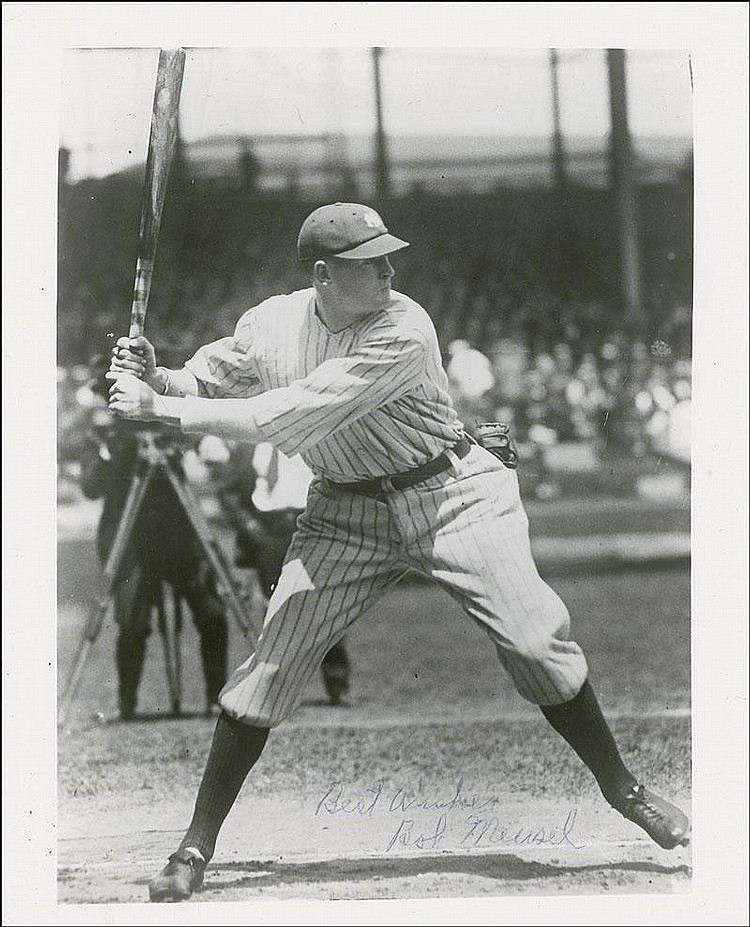
  A leadoff triple in the second by Bob Meusel led to the game's first run, as Gehrig followed with a sacrifice fly to center. Combs manufactured another run the next inning, with a lot of help from the White Sox. After reaching on a fielder's choice, he stole second, drew a throwing error by Schalk to get to third, and raced home when Mostil threw wildly to Kamm at third.
  (Schalk's throwing error was uncharacteristic. Elected to the Hall of Fame largely for his defense {.253 career batting average}, he would league American League catchers this year by throwing out 71.8 percent of the runners trying to steal on him. Five times he led the league's backstops in fielding percentage.)


Bob Meusel's 4-for-4 day at the plate was overshadowed by Babe Ruth's walk-off grand slam homer as the New York Yankees defeated the Chicago White Sox 6-5 in 10 innings on Sept. 24, 1925. Meusel was on deck when Ruth won the game.
  By bringing a sudden end to the game, Ruth prevented Meusel from adding to his hitting heroics. Meusel, the Yankees' cleanup hitter, was on deck and had been 4-for-4 on the day when Ruth struck his decisive blow.
  Kamm, a shining light for the White Sox in their post "Black Sox" days and noted as one of the greatest defensive third basemen of all time, led the Chicago offense this day, going 2-for-2.

Before and after

  As noted before, 1925 was an outlier for the Yankees in this decade. After their Sept. 24 win they were 66-82 and seventh in the AL, 30 1/2 games behind first-place Washington, and they finished 69-85, in seventh and 28 1/2 out of first.
  It was defininely a year of transition. Besides having to play much of the year without Ruth, they were also breaking in Gehrig and Combs.
  But those three combined with rookie second baseman Tony Lazzeri and Koenig, newly installed as the regular shortstop, to help the Yankees reclaim the pennant in 1926 through 1928, winning the World Series in '27 and '28.
  Rush, Meusel and third baseman Joe Dugan were the only position player regulars who bridged their 1921-23 pennants and the ones in 1926-28.
  As for the 1925 White Sox, they were long gone from their days of glory and disgrace. Those included winning a World Series in 1917 and losing one in 1919 before it was discovered, one year later as they were chasing another pennant, that eight players had conspired to throw the '19 Series, tagging that team forever as the "Black Sox."
  The eight players implicated were immediately banned from baseball, and the White Sox lost out on the pennant, then subsequently became a perennial bottom feeder in the AL. They stood at 74-75 and in fifth place in the AL after their Sept. 24, 1925, loss and finished at 79-75 and in fifth. That was quite a significant improvement from 66-87 and eighth the year before, but it would be until 1936 that they finished in the upper division again and 1959 before they won another pennant.
  Faber, Kerr, Schalk and Collins, nearing the end of his immortal Hall of Fame career at second base, were the only holdovers in 1925 from their 1917-20 powerhouses.
  Kerr, who'd been a hero amid the disgrace with two wins in the 1919 World Series, had just made his reappearance with the White Sox in August since he'd been suspended in 1921 over salary squabbles he had with the team. But soon his four-year major league career was over. He made his second-to-last appearance in a major league game when he pinch ran Sept. 24. He pitched a final game Oct. 4, then was released and played out his career in the minor leagues.
  Later Kerr became known, when he was a minor league manager, as a mentor to Stan Musial. Musial even named a son after him.

Sources:

Play-by-play:https://www.retrosheet.org/boxesetc/1925/B09240NYA1925.htm  and  https://sabr.org/gamesproj/game/september-24-1925-babe-ruth-beats-white-sox-extra-inning-walkoff-grand-slam
Ruth's off-the-field woes: http://baseballegg.com/2012/11/29/babe-ruth-and-baseballs-most-famous-bellyache/

Ruth's home run log: http://baseball-reference.com:8080/players/event_hr.cgi?id=ruthba01&t=b 
Additional background came from various sources on the Retrosheet and Society for American Baseball Research's Biography Project and Games Project websites, as well as baseballreference.com. 

Saturday, April 4, 2020

8-12-66: Shamsky's clutch-homer show falls shy


Art Shamsky came off the bench to hit homers in three straight at-bats for the Cincinnati Reds on Aug. 12, 1966. The first homer put the Reds ahead, and the next two tied the game in extra innings. But it wasn't enough as the Pittsburgh Pirates prevailed 14-11 at Crosley Field in a game that featured 11 homers, eight lead changes and seven ties.

By Phil Ellenbecker
  Art Shamsky is a fondly remembered member of the 1969 Amazin' Mets. Enough so that the character Robert on the TV series "Everybody Loves Raymond" named his dog Shamsky.
  After hitting a career-high .300 in 1969 with 14 homers and 47 RBIs during the regular season, he went on to hit .538 and lead both teams in hits with seven as the New York Mets swept the Atlanta Braves in the first-ever National League Championship Series.
  “I’ll walk down the street in New York now and people will say, ‘There’s Art Shamsky of the Mets.’ People used to laugh. They won’t anymore," Shamky told the New York Daily News after his NLCS performance, as quoted in his Society for American Baseball Research biography.
  He wasn't a factor in the Mets' 4-1 triumph over Baltimore in the World Series, going 0-for-6, but nevertheless his status among Mets fans was cemented, particularly among the area’s large Jewish population.
  But as amazin' as the 1969 Mets and Shamsky were, what was really amazin' about Shamsky's career was what he did while with the Cincinnati Reds against the Pittsburgh Pirates on the Friday night of Aug. 12, 1966, at age 24 and in his second season in the major leagues.
  What he did was come off the bench and homer in three straight at-bats, the first putting the Reds ahead, the next two tying the game in extra innings.
  Alas, the Reds couldn't get him up one more time. He was two batters away when Leo Cardenas grounded into a double play, giving the Pirates a chaotic 14-11 victory in 13 innings before a Shrine Night crowd of 25,477 at Cincinnati's Crosley Field.
  Teammate Pete Rose told Earl Lawson of the Cincinnati Post Shamsky's power display was “one of the greatest clutch-hitting exhibitions ever seen.”
  And Shamsky wasn't through. He didn't play in the next day's game against Pittsburgh, but he came off the bench and homered for a fourth straight time Sunday. His homers in four consecutive at-bats ties him with several others for the major league record.
  "I can’t say I tried to hit any of them. … It’s a funny thing. They come pretty easy when I don’t try," Shamsky told Jack Disney of the Los Angeles Herald Examiner after the conclusion of his streak.
  Getting back to Friday, how chaotic was it on Shrine Night, how frenzied before the fezzes? The game, which lasted 4 hours, 22 minutes, included eight lead changes and seven ties. The two teams combined for 11 homers, accounting for 17 of the runs scored. Each team used 20 players. The Pirates used six pitchers, Cincy five. They issued a combined 17 walks, four of them intentional as the constant flow of base runners brought on the need for tit-for-tat tactics. There was enough shuffling going on that two of the Hall of Famers in the game, Willie Stargell and Tony Perez, were each pinch hit for.
  (It should be noted that Perez didn't really emerge until a 26-homer season in 1967. And Stargell, even though he hit 33 homers in '66, also hit only .169 this year against left-handers and was set to face southpaw Billy McCool.)
 "Those who played and witnessed this contest repeated over and over, ‘Doggonedest’ game I ever saw,' " reported Lester J. Biederman in The Sporting News, as quoted in an article by Russell Lake for the SABR's Games Project.

All-time great pinch hitter Manny Mota, shown in his days with the Los Angeles Dodgers, came off the bench and put the Pittsburgh Pirates ahead for good with a two-run 13th inning single in a 14-11 victory over the Cincinnati Reds on Aug. 12, 1966.
 It was Stargell's replacement, Manny Mota, who provided the telling blow by bouncing a two-run single to left field off McCool that put the Pirates ahead 13-11 in the top of the 13th inning, scoring Matty Alou and Bob Bailey. Roberto Clemente, the most renowned of the Pirates' three Hall of Famers in the lineup, scored on a wild pitch by Jack Baldschun to make it 14-11.
  Chico Ruiz batted for Baldschun leading off the Cincinnati 13th and singled. But Tommy Sisk, the last of Pittsburgh's six pitchers, brought a halt to the Crosley craziness. First he struck out Tommy Helms looking. Then he got Cardenas to hit a hard grounder to second baseman Bill Mazeroski, who snatched it and started a 4-6-3 double play with shortstop Jose Pagan to end the game.
  It was somewhat appropriate and at the same time ironic that the slugfest should end with Mazeroski, who was elected to the Hall of Fame largely on his defense, turning a twin killing. The eight-time Gold Glove winner would lead the league's second baseman in double plays turned this season and is the all-time leader in that category after leading the league eight times.
  But before Mota and Mazeroski came along, it was mainly a home-run derby, led by Shamsky. His two-run homer in the eighth inning gave the Reds an 8-7 lead. His solo shot in the 10th tied it at 9. Another two-run blow made it 11-11 in the 11th. The last was Shamsky's 15th homer en route to a career-high 21.
 By going 3-for-3 with three runs scored and five RBIs, he set career highs for homers, runs and RBIs in a game.
Bob Bailey went 3-for-7 with two homers, five RBIs and three runs scored to help the Pittsburgh Pirates topple the Cincinnati Reds 14-11 in 13 innings on Aug. 12, 1966.
 Right up there in the slugging department was the Pirates' Bailey, who belted two homers and finished the day 3-for-7 with three runs and five RBIs. He hit his eighth and ninth homers on the year in the sixth and seventh innings after striking out his first two times up.
 Three of the Hall of Famers also weighed in with circuit clouts. Stargell had a solo homer in the 10th, his 27th of the year, to put Pittsburgh ahead 9-8. Clemente had a solo shot in the third. It was the 20th of a career-high 29 the eventual National League MVP hit in 1966.
 And all-time hits leader Pete Rose had a two-run blast for the Reds in the fifth inning, part of a 2-for-4 day that also included three walks, two of them intentional. This was also a career homer year for Rose, not known for his power. It was his 12th dinger in a season he'd hit 16, tying his best.
 Also homering for the Pirates were former Red Jesse Gonder, with one on in the third, and Jerry Lynch, also a former Red, with a solo shot in the ninth. Deron Johnson had a two-run homer for the Reds in the first. (That kept Johnson from an ignominious collar on the day, as he went hitless from there and finished 1-for-7.)
  Lynch's homer was part of a big day for all-time great pinch hitters for the Pirates. He tied the game at 8 in the top of the ninth with one of his record 18 pinch homers. (He also has the record for pinch homers in a season with five, set with Cincinnati in 1961.) And although Mota's go-ahead single in the 13th was his second time up so it doesn't count as a pinch hit, it was certainly pinch-like, and he ranks third all time in pinch hits with 150. He was the career leader until Lenny Harris passed him in 2001. (Harris finished with 212.)  
  Sisk got the win and moved to 6-2, throwing two scoreless innings and allowing one hit. McCool was tagged with the loss and moved to 7-7. He gave up four hits and five runs, four earned, while walking six -- two of them intentional passes to Clemente.
   After Lynch knotted the score, Roy Face came on in relief for the Pirates and extended the game into extra innings by striking out the side. Stargell and Shamsky matched homers in the 10th, and then the Reds nearly ended it by loading the bases on walks to Tommy Harper and Rose (intentionally) around a single by Vada Pinson, who went 3-for-7 on the day.
  But with one out, Face kept the game tied by retiring Johnson on a fly out and striking out Mel Queen. Queen, normally a pitcher, batted for Don Nottebart, Cincinnati's third pitcher on the day.
  McCool then came on to start the 11th and surrendered a two-run double to Bailey, who came close to a third homer by reaching the wall in left-center. Mota ended Pittsburgh's turn by grounding into a fielder's choice batting for Stargell.
  Shamsky kept it alive by homering off Billy O'Dell, who'd just relieved Face, with two out in the bottom of the 11th with Johnny Edwards aboard. Shamsky sent a 3-1 pitch off the right-field foul pole screen.
  The Pirates put runners at second and third with two out in the 12th, but McCool got out of the jam by striking out Jim Pagliaroni looking. Sisk retired the Reds 1-2-3 in the bottom half.
  Matty Alou, capping a 3-for-5 day, singled leading off the top half of the 13th. Bailey reached second and Alou third when Helms botched a would-be double play grounder down the third-base line for an error. Clemente was walked intentionally. Mota followed with his decisive two-run hit, putting a damper on Shamsky's heroics. After the game, he declined an opportunity to go on a Cincinnati postgame radio show, Star of the Game. “How can you be a star when your team loses?”  Shamsky said, according to Si Burick in the Dayton Daily News.

Most improbable

  Win probability added (WPA) is a statistic that attempts to measure a player's contribution to a win by figuring the factor by which each specific play made by that player has altered the outcome of a game.
  According to a list at baseballreference.com that takes in games from 1916 through 2013, Shamsky's WPA for the night of Aug. 12, 1966, was the highest ever recorded. What this means, as explained in a Baseball Prospectus article by Michael Baumann, is that in that game Shamsky did more than anyone before or since to help his team win.
  That's impressive enough, but what makes it more impressive, or improbable shall we say, is that as Baumaann notes, the players with the highest WPAs in history are typically really good players, they started the game and they played on the winning team. 
   Shamsky strikes out on all three counts.
 "That’s when Shamsky’s performance on August 12, 1966, stops being laudable and historically interesting and starts being truly bizarre," Baumann writes.

And he wasn't done

 After sitting out the Pirates' rain-shortened 11-0 victory over the Pirates the next day, Shamsky hit his fourth consecutive home run Sunday with a pinch-hit two-run shot during the seventh inning of a 4-2 Pirate win. In his next at-bat, the next night in Los Angeles at Dodger Stadium, he settled for a single in the eighth inning.
 The Los Angeles Herald-Examiner ran a parody of “Casey at the Bat” that concluded, “But there is no joy in any town — just tears and sadness mingled; After four straight homers, mighty Shamsky only singled."
  Shamsky finally earned a start in right field the next night, but went 0-for-3 to snap his 5-for-5 streak.
  As noted at the top, Shamsky's four homers in four consecutive at-bats  ties him for the major league record. He is one of 17 players to hit four straight homers over a span of two games and the only major leaguer to hit three home runs in a game without being in the starting lineup.
  Shamsky went on to play eight years in the major leagues and had a .253 lifetime batting average with 68 homers and 233 RBIs.

Sources:

Additional background came from various sources on the Retrosheet and Society for American Baseball Research's Biography Project and Games Project websites, as well as baseballreference.com. 


Wednesday, April 1, 2020

Magic Royals moments, 8-17-76: Walk-off steal some early Brett mojo

George Brett kisses home plate after playing his final home game for Kansas City at Royals Stadium, in 1993. Brett had a different treatment of home plate, stealing it, to give the Royals a 4-3 victory in 10 innings over the Cleveland Indians on Aug. 17, 1976.
By Phil Ellenbecker
  George Brett could beat you with the bat. Oh, could he. Numerous times, most notably in postseason play.
  And he could beat you with the glove, most notably a dazzling backhand stab and jump throw to the plate to nail a runner in Game 3 of the 1985 American League Championship Series. https://www.youtube.com/watch?v=t8c4E4I082E
  And although it didn't come in postseason play, Brett won a game on the bases on Aug. 17, 1976, in an early indication of what a thoroughly clutch player he was going to be throughout his career.
  Brett stole home with two outs in the 10th inning that night at Royals Stadium, giving Kansas City a 4-3 victory over the Cleveland Indians before 14,386 at Royals Stadium.
  Brett doubled and came around to score on his first at-bat of the night, in the third inning, and from then on he was just determined to keep going around the bases. It didn't work out so well when he was caught stealing by Indians catcher Ray Fosse after singling in the fifth.
  But undeterred, Brett set sail again after singling with one out in the 10th off Dave LaRoche, making the eventual 1976 American League batting champ 3-for-5 on the night.
  This time, with Rick Cerrone having replaced Fosse after Fosse had been pinch hit for in the ninth, Brett drew a wild throw on his steal attempt and went on to third base. Cerrone, a rookie, was appearing in just his 10th major league game.
  Then, after John Mayberry struck out and with Dave Nelson up at the plate, Brett took off yet again on a 1-1 count.
  Taking advantage of the full windup the left-hander LaRoche used, Brett easily slid in safely to give the Royals a fourth straight win en route to their first AL West title.
  Brett's two stolen bases gave him 17 in a year he'd finish with 21, second-best behind his 1978 career high of 23. Yet his total was only fifth-best on a team that swiped 218 bags on the year, second-most in the major leagues. And the only reason the Royals didn't lead the majors that year was that Oakland set an American League record with 321. The next-closest to K.C. was world champion Cincinnati with 210.
  That's the kind of baseball Brett and the Royals played back then under manager Whitey Herzog, and that Herzog-led teams would continue to do in the 1980s when he guided the St. Louis Cardinals.
  (Besides stolen bases, Brett and McRae specialized in stretching singles into doubles against lazy outfielders taking their time getting to the ball.)
  Going into the ninth inning it didn't look like they'd need such tactics, holding a 3-1 lead. "Some of the crowd headed toward the exits confident of another Royals win," Jan Larson wrote in an article for the Society of American Baseball Research's Games Project.
  But the Indians extended the game with a two-run ninth on a throwing error by Kansas City shortstop Fred Patek and a single by George Hendrick.
  The Indians set up the game-tying inning on a walk to Tommy Smith and a single by Rico Carty, which brought on Steve Mingori in relief of Doug Bird. When Patek threw wildly on pinch hitter Larvell Blanks' grounder, Smith raced home from second, and Herzog went to relief ace Mark Littell. Hendricks followed with a hit that scored Rick Waits. Waits, a pitcher, had been called on to run for Carty.

Mark Littell had 1 2/3 innings of shutout relief to get the win in the Kansas City Royals' 4-3 decision over Cleveland on Aug. 17, 1976. Littell, in his first full season in the major leagues, improved his record to 7-3 and finished the season 8-4 with a 2.08 ERA and 16 saves. 
  With runners at first and second, Littell got the next two batters and then three in a row in the 10th to earn the win. Littell improved to 7-3 with his 1 2/3 innings of shutout relief with the help of two strikeouts. Littell would finish the year, his first full season in the major leagues, with an 8-4 record, a 2.08 ERA and 16 saves.
  LaRoche took the loss and fell to 1-4, allowing two hits and one unearned run over three innings in relief of Pat Dobson. Dobson survived shaky control -- four walks and two wild pitches -- as he scattered nine hits and gave up three runs, all earned, in 6 2/3 innings with three strikeouts.
  Bird, who had a 10-5 record coming in, pitched 8 1/3 innings and allowed six hits and three runs, two earned, while walking three and striking out two.
  The Royals scored single runs in the fourth and seventh innings to take a 3-1 lead. Brett's double and singles by John Mayberry and Hal McRae put them ahead in the fourth. Amos Otis increased the lead to two in the seventh with a single that scored Patek. Patek had reached on an infield single, moved to second on Frank White's sacrifice bunt and advanced to third on Al Cowens' ground out.
  Otis finally got through to left field for his RBI hit after grounding out to third his first three times up.
  Cleveland took the early lead on doubles by future Royals manager Buddy Bell and Frank Duffy in the third. The Royals matched that in the bottom half when White singled in Buck Martinez. Martinez led off with a single, went to second on a wild pitch and moved to third on a Patek single.
  But with runners at first and second and still none out, Dobson escaped further damage when Fosse threw out White attempting to steal, Cowens popped out and Otis grounded out.
  Patek went 2-for-4 and McRae 2-for-3 in the Royals' 11-hit attack.
  Carty led the Cleveland offense, going 2-for-4.
  In the grand scheme of things, this win didn't greatly help the Royals' cause, as at this point they led the AL West by eight games. But the way they won it was a further illustration that they and especially Brett were a team to be reckoned with. Winning a game with a walk-off steal was something special.
  "As 1976 was before the age of the internet and SportsCenter, only a fortunate few actually got to see the remarkable play," Larson wrote. "Less fortunate still were those who left the stadium two innings earlier trying to beat the traffic."
  Brett's grand entrance into the spotlight came at the end of the season when he won the American League batting title in a controversial finish over teammate McRae. Then people really began to take notice when he hit a game-tying three-run homer in the eighth inning of the deciding Game 5 of the AL Championship Series.
  Alas, the Royals came up short in that game when Chris Chambliss hit a homer leading off the bottom of the ninth off Littell to give the New York Yankees a 7-6 win and their first pennant since 1964.
  But as it turns out, the Royals and Brett were just getting started. Three straight division titles, 1976 through 1978, then a pennant in 1980 and finally a World Series title in 1985. And lots of Brett magic along the way.

Sources:

Play-by-play: https://www.retrosheet.org/boxesetc/1976/B08170KCA1976.htm and https://sabr.org/gamesproj/game/august-17-1976-george-brett-steals-win-royals
Team stolen base records:  https://www.baseball-almanac.com/recbooks/rb_stba2.shtml  
Additional background came from various sources on the Retrosheet and Society for American Baseball Research's Biography Project and Games Project websites, as well as baseballreference.com.